
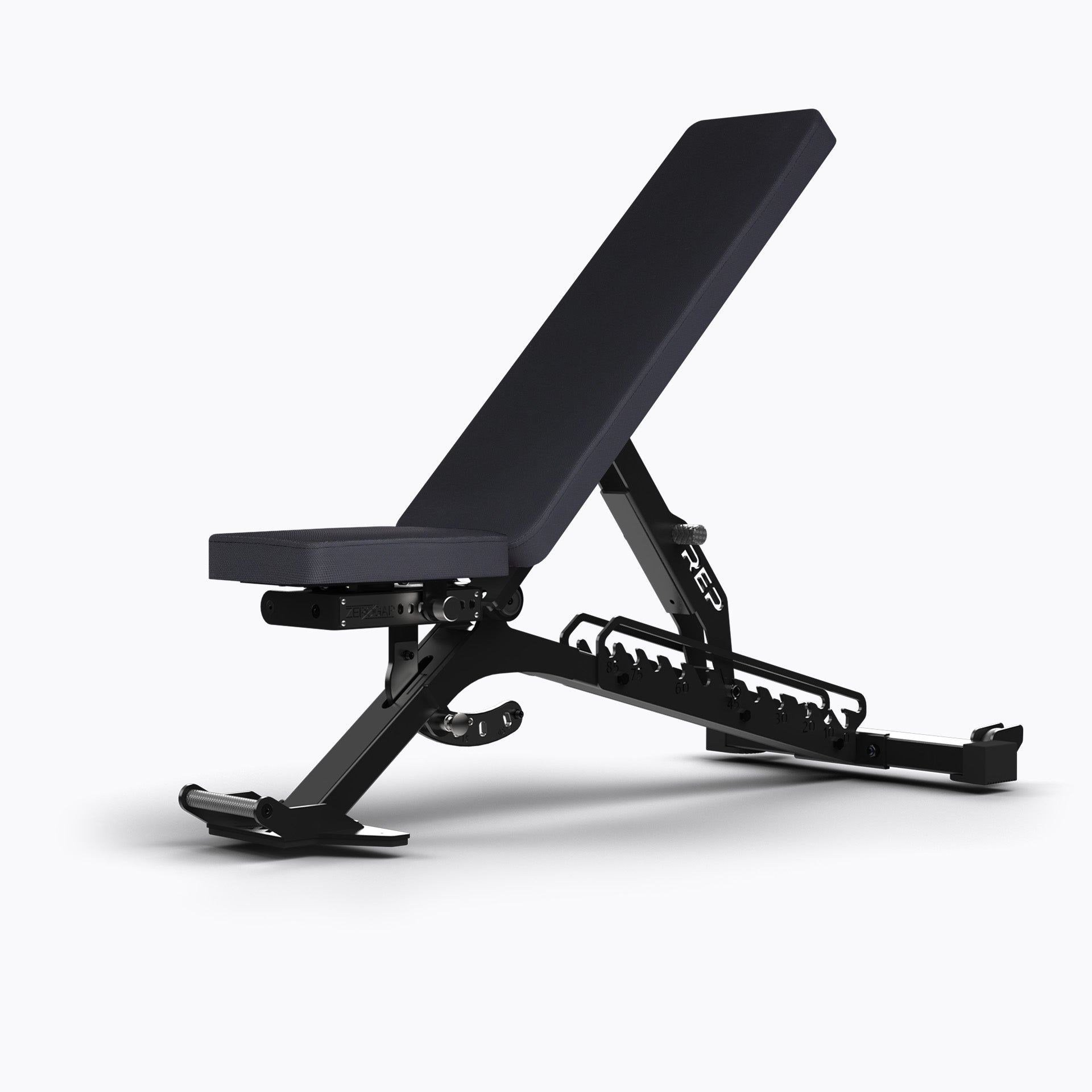
Your needs, this model
Does it fit your priorities?
Does the standard-pad BlackWing meet a 1,000-lb stated-rating threshold?
REP lists a 1,000-lb capacity for the BlackWing family, including the standard-pad option. This is the manufacturer's published rating, not an independent test, and the source does not settle every user's combined bodyweight-and-training-load interpretation.
Explore this need in the finder →Can the standard-pad BlackWing be stored vertically?
REP describes an integrated upright storage stand and lists a 3.1-square-foot vertically stored footprint. The 10.7-square-foot figure is the bench's floor footprint during use; neither number includes clearance, a lifting route or rack space.
Explore this need in the finder →Does this decline-capable bench include a leg restraint?
No leg restraint is listed as part of the standard BlackWing bench package. REP describes the Leg Roller Attachment as optional and compatible, so buyers should verify it as a separate line item rather than assume that a negative back angle includes a way to secure the legs.
Explore this need in the finder →Why choose the standard pad over the wide version?
REP lists the standard back pad at 12.2 inches and says the standard option meets all of its cited IPF dimensions, including width. The manufacturer notes that a wide pad may restrict full range of motion for some smaller lifters; individual fit still depends on the lifter and exercise, not the label alone. The finder can identify this AB-5300 configuration when a visitor explicitly selects the BlackWing Standard-pad option.
Explore this need in the finder →This assessment covers the standard-pad configuration of REP's current BlackWing adjustable bench. It is a source-based comparison of the published model and variant data, not a physical inspection or load test. The configuration matters: REP sells the same BlackWing frame with either a standard or wide pad, and the useful difference is not another angle or a different rating but the surface width under the lifter.
The standard pad is the competition-width choice
REP lists a 12.2-inch-wide back pad for the standard option. Its bench FAQ says this pad width falls within the dimensions it cites for IPF rules; the same FAQ says the wide option does not meet the width limit. That makes Standard the one to examine if your selection depends on the manufacturer-stated competition dimensions. It is not an independent certification, and a compliant bench width alone does not establish that a particular meet, lifter or complete setup is eligible.
The seat pad is also listed at 12.2 inches at its widest point and tapers to 8.5 inches. REP specifies a 38.2-inch back pad and a 15.6-inch seat. Those measurements help distinguish it from a broader pad, but they cannot predict how your shoulders or preferred benching position will feel. REP warns that some smaller lifters may lose range of motion on the wide version; individual fit still needs a real comparison with your body and training style.
A broad adjustment range, with a separate restraint question
The back has twelve listed positions, from -8° through flat to 85°; the seat has six positions, from -10° to 45°. REP calls the bench flat, incline and decline capable. It also describes its ZeroGap seat as sliding forward and backward to eliminate the gap between pads in all positions. The feature is attractive on paper if the changing seat-to-back distance is a concern, but REP does not publish a fixed gap measurement for this model. It is more precise to describe a movable gap-control feature than to treat “zero” as a verified, permanent measurement.
Do not equate a negative back angle with a leg hold. REP lists the Leg Roller Attachment as an optional compatible add-on, not part of the standard-pad bench itself. The base configuration therefore fails a requirement that a restraint be included, even though its backrest has a decline angle. If decline work with secured legs is essential, confirm the attachment, compatibility, package and instructions separately. The current sources reviewed here do not establish whether the optional roller may stay attached during upright storage, so that combination needs a direct manufacturer check.
Space and moving deserve their own decision
REP lists this bench at 131 lb, 59.5 by 25.8 inches, 17.2 inches high when flat, and 10.7 square feet of floor footprint. It also says an integrated stand allows vertical storage in 3.1 square feet. The smaller stored footprint does not include the clearance needed to tip or lift a 131-lb bench, a safe route through the room, or space around a rack. Measure all three: the exercise envelope, the place where it rests between sessions, and the route between them.
REP highlights a horizontal knurled stainless-steel handle for maneuverability, but the reviewed specification list does not document transport wheels. I would not count on wheels from the handle description. If the bench will be moved often, check the current product photos and instructions and decide whether its weight and handling arrangement suit the person who will move it. A stated upright-storage capability should not be read as proof that the transition is easy or safe for every user.
Rating and construction are maker claims
The manufacturer lists 11-gauge steel, CleanGrip pads, knurled stainless-steel handles and a 1,000-lb capacity. These are specific published attributes, not results from our testing. REP does not explain on this page how the rating should be divided between user weight and external load in every exercise, nor does this assessment infer a tested safety margin from steel gauge. Before training, consult the current manual, inspect the exact unit and ask REP how the rating applies to your intended use.
Where it sits beside other REP options
The AB-3000 2.0 offers a lower listed back angle (-12°), an included multi-position leg-roller assembly and a 1,000-lb maker rating, but REP says it is not designed for vertical storage. The Nighthawk/AB-4102 is lighter at 88 lb and stores upright, but its 700-lb rating and flat-to-incline base range differ from the BlackWing. These are different tradeoffs, not a ranking: compare the exact angle, included restraint, pad size, stored footprint and rating you actually require. Our separate AB-3000 2.0 assessment and Nighthawk assessment describe those configurations.
Who should shortlist the standard version
The standard-pad BlackWing makes the clearest case for a buyer who wants a broad flat/incline/decline range, an upright storage option, and the narrower pad that REP says stays within its cited competition-width limits. It is a poor fit if you need the restraint included, want a bench you can move lightly, need to fit within a footprint below 10.7 square feet, or prefer the 14-inch surface. REP's seven finish choices are cosmetic variants; the Metallic Black image shown here is an example, while the fact and review concern the Standard-pad SKU family. Confirm the AB-5300 prefix, Standard selection, exact finish, accessory contents, dimensions and current manual before treating a seller's bundle as equivalent.
Key specifications
Key details at a glance
| Adjustment range | Flat / incline / decline |
|---|---|
| Manufacturer-stated capacity | 1000 lb |
| Bench weight | 131 lb |
| Length | 59.5 in |
| Width | 25.8 in |
| Height when flat | 17.2 in |
| Base footprint area (listed or calculated) | 10.7 sq ft |
| Back-pad positions | -8 / 0 / 10 / 20 / 30 / 37.5 / 45 / 52.5 / 60 / 67.5 / 75 / 85° |
| Seat-pad positions | -10 / 0 / 8 / 15 / 30 / 45° |
| Leg restraint included | No |
| Vertical storage supported | Yes |
Use the exact model’s instructions for operating limits, supplied equipment and version differences.
Sources for this review
Sources for this assessment
Compare the constraints that matter to you
Use the finder to compare currently researched benches, and opt in to the five separately assessed earlier REP configurations or families only when checking an existing or used offer. Match the exact model, edition and manual; the catalogue is still being expanded.