
Your needs, this model
Does it fit your priorities?
Does the bench include a restraint for decline work, or is that a separate purchase?
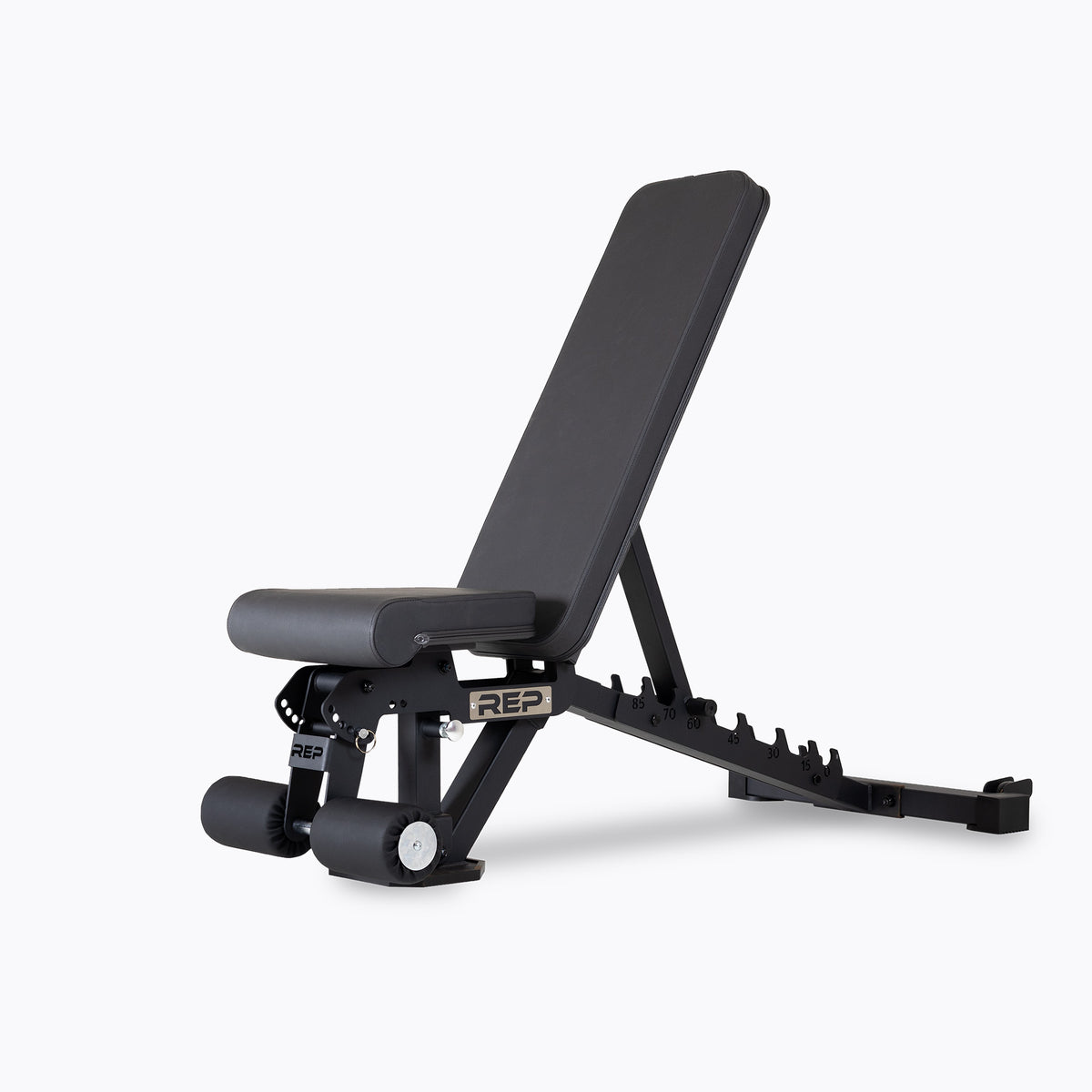
REP describes the AB-3000 2.0 as an FID bench with built-in leg rollers and an adjustable pin. The manufacturer lists six roller positions. Check the exact listing and delivered package before ordering, especially if a marketplace offer has been bundled or reconfigured.
Explore this need in the finder →Can I stand it upright after a session to clear the floor?
No. REP's product FAQ says the AB-3000 2.0 cannot be stored vertically. Its wheels help reposition the 89.3-lb bench, but they do not make it a folding or upright-storing model.
Explore this need in the finder →How does it compare with REP's simpler AB-3100?
The AB-3000 2.0 has eight back positions including decline, a built-in leg-roller assembly, and a published 1,000-lb rating. REP lists the AB-3100 at 700 lb with six back angles, flat-to-incline only, and no leg roller. The AB-3000 2.0 is also heavier (89.3 versus 70 lb) and has the larger stated footprint (9.85 versus 7.9 sq ft). These are manufacturer specifications, not head-to-head tests.
Explore this need in the finder →This is a specification-based assessment of the current U.S. AB-3000 2.0, using REP’s product page and bench documentation. We did not assemble, own, or load-test the bench. Its appeal is easy to understand on paper: it combines flat, incline, and decline positions with a leg-roller assembly that is included rather than left to an accessory decision.
What the 2.0 configuration actually adds
The “2.0” suffix matters. REP’s own comparison with the earlier AB-3000 identifies changes to the base covers, numbered adjustment ladder, and leg-roller handle. More importantly for choosing a training setup, the 2.0 has eight backrest positions: -12°, flat, then 15°, 30°, 45°, 60°, 70°, and 85°. The earlier bench’s incline steps were different. The new bench also locks its roller assembly into six positions, while the older version’s roller arrangement did not offer that same locking adjustment. Do not use a listing that just says “AB-3000” as proof that it is this edition.
The five seat settings—0°, 5°, 10°, 15°, and 20°—let the seat angle change independently of the back pad. That matters because the back pad can move to a steeper angle without leaving the seat flat. For a buyer who routinely switches among flat presses, incline dumbbell work, and decline movements, the range is more useful than a single “number of positions” headline. Still, 85° is not 90°; if you need a fully upright seat-back position for a particular exercise, this model’s published back-angle list does not promise one.
Decline capability is not just an angle
The -12° setting makes this a flat-incline-decline bench rather than a flat-to-incline model. The included leg rollers and adjustable pin are an important part of that package: they provide a way to secure the lower body for decline work without assuming that a separately sold attachment will fit. Six roller positions offer some adjustment for leg length and setup preference, but the published specification does not tell us how every user will find the fit. Check the roller position and the exact setup instructions rather than treating “decline” as a guarantee of comfort.
The back pad is 36 inches long and 11.8 inches wide in the standard configuration; REP says a wider back pad can be bought separately. The standard seat is 15 inches wide and 15 inches long. The stated gap is 2.1 inches. Those dimensions are more informative than a generic claim of a “comfortable pad,” particularly if you know you prefer a wider surface or want to avoid a gap during a movement. The manufacturer calls the cover CleanGrip and describes the 2.0 pad as an update from the prior version, but we cannot turn that material label into a personal comfort verdict.
Plan for a heavy, floor-resident bench
REP lists the bench at 89.3 lb, 56.6 inches long, 25.8 inches wide, 17.1 inches high when flat, and 9.85 square feet of footprint. The company also says it cannot be stored vertically. This is therefore a poor fit for a room where the bench must be stood against a wall after every workout, even though the product includes wheels and a horizontal handling bar for repositioning. Measure the route through doorways and the intended storage spot; a wheeled bench still needs a place to live.
The frame is listed as 11-gauge steel, with rubber covers on the bases. Those are useful construction and floor-contact details, not an independent stability test. REP’s stated 1,000-lb capacity should likewise be treated as the maker’s rating, not as a promise about every combination of user, weights, exercise, pad position, or rack. The page does not define the rating’s test method or explain whether a buyer should interpret it as a combined user-and-load figure. If the rating is a decisive safety threshold for your setup, confirm the precise limit with REP and follow the manual for the exact edition.
Where it sits against a simpler adjustable bench
REP’s AB-3100 illustrates the tradeoff within the same brand. The AB-3100 is a lighter, smaller flat-to-incline design with no decline position or leg roller, six back settings from 0° to 90°, and a 700-lb published rating. The AB-3000 2.0 instead adds decline, a much more configurable leg restraint, and a higher stated capacity, at the cost of more weight and floor area. That is a real feature difference, not a ranking: a buyer who will never use decline may reasonably value the lighter footprint more.
Shortlist it when the extra range will be used
This is a sensible candidate to investigate if you want decline work and prefer the lower-body restraint to be included in the bench package. It is less compelling if your sessions are almost entirely flat and incline, if upright storage is essential, or if you want a very light bench to carry up stairs. The listing’s color choices do not change this model-level assessment; the metallic-black image here represents one finish, not a separate performance version.
Before buying, verify that the offer says “AB-3000 2.0,” identify whether the standard or a separate wide pad is included, and compare the delivered package with REP’s current instructions. Check the bench’s real dimensions against the space you measured, confirm the capacity interpretation for your use, and inspect the pins and roller arrangement specified for the model. This review is a starting point for those checks—not a substitute for the manufacturer’s operating instructions or a hands-on evaluation.
Key specifications
Key details at a glance
| Adjustment range | Flat / incline / decline |
|---|---|
| Manufacturer-stated capacity | 1000 lb |
| Bench weight | 89.3 lb |
| Length | 56.6 in |
| Width | 25.8 in |
| Height when flat | 17.1 in |
| Base footprint area (listed or calculated) | 9.85 sq ft |
| Back-pad positions | -12 / 0 / 15 / 30 / 45 / 60 / 70 / 85° |
| Seat-pad positions | 0 / 5 / 10 / 15 / 20° |
| Pad gap | 2.1 in |
| Leg restraint included | Yes |
| Leg-roller positions | 6 |
| Vertical storage supported | No |
| Transport wheels shown | Yes |
Use the exact model’s instructions for operating limits, supplied equipment and version differences.
Sources for this review
Sources for this assessment
Compare the constraints that matter to you
Use the finder to compare currently researched benches, and opt in to the five separately assessed earlier REP configurations or families only when checking an existing or used offer. Match the exact model, edition and manual; the catalogue is still being expanded.