
Your needs, this model
Does it fit your priorities?
Does the Westside Bench 2.0 adjust to incline or decline?
No. Rogue describes a fixed, flat bench pad on a station whose height can be changed in one-inch increments. The adjustable upright height is not a backrest angle adjustment, so the model does not meet an incline or decline requirement.
Explore this need in the finder →Which package is included in the Westside Bench 2.0 footprint figure?
The 52.5-by-34-inch figure is the maker's listed station footprint; it calculates to about 12.40 square feet before working clearance. Spotter decks are optional and raise listed mass from 213 to 250 pounds, but Rogue gives no added floor dimensions, so a deck-equipped package does not get a numeric area match.
Explore this need in the finder →How should I interpret Rogue's 1000+ lb capacity statement?
The matcher uses 1,000 pounds only as the conservative lower bound stated by Rogue, not an independent test or proof of a higher value. The source does not explain whether the rating combines user and external load, so verify the maker's definition and exact instructions for your setup.
Explore this need in the finder →Research-based assessment · base SKU RF0677-180 with options retained · not a hands-on test
A current fixed station with a stated 1000+ lb floor
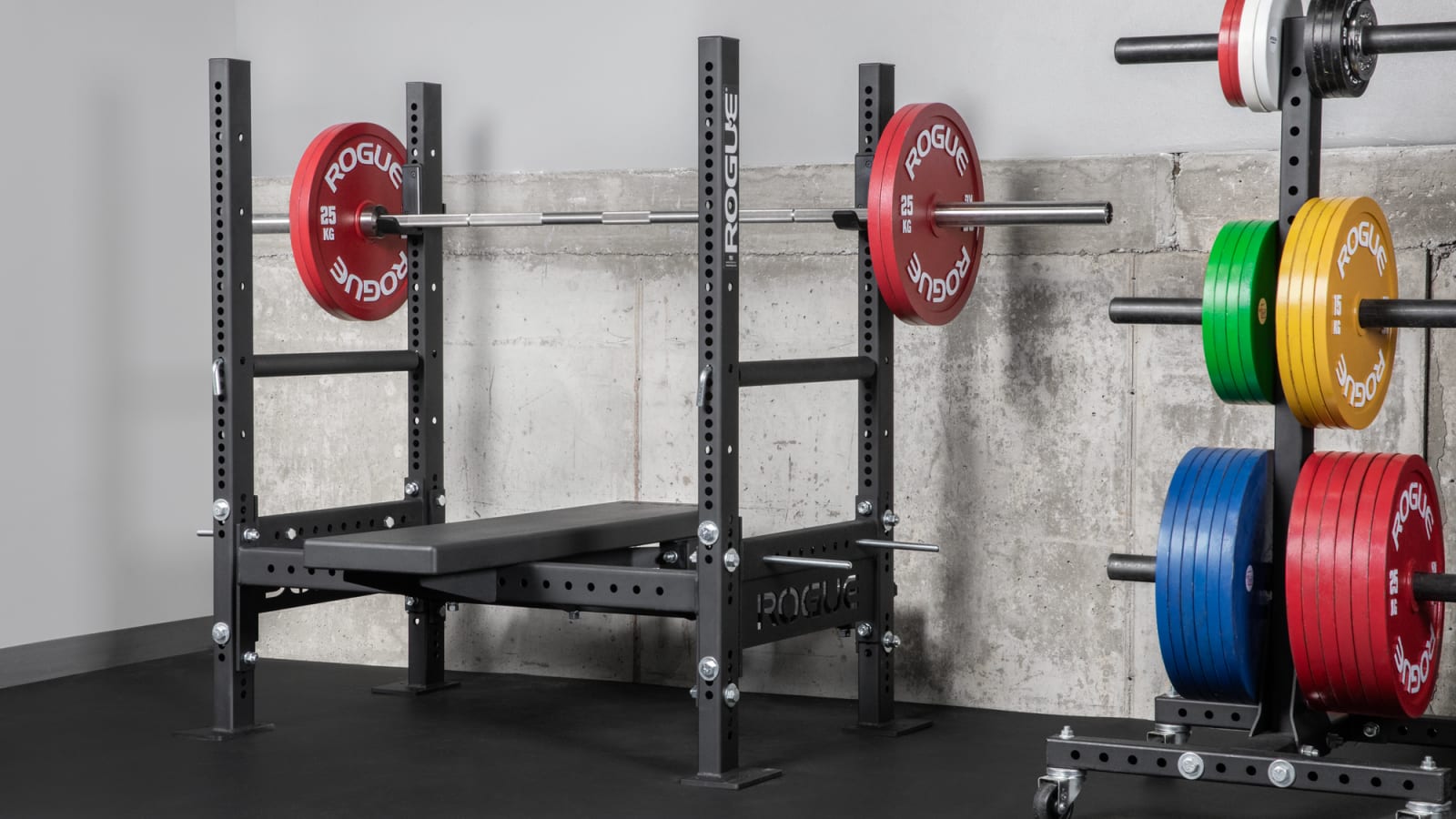
The Rogue Westside Bench 2.0 is a dedicated fixed-flat bench-press station rather than a free-standing utility bench. Its current U.S. page identifies a ProductGroup called WESTSIDE2 and four exact package SKUs: RF0677-180 and RF0677-FP without optional spotter decks, plus RF0677-180-SS and RF0677-FP-SS with decks. The suffix choices cross two pads—Premium Textured Foam at 47 by 12 by 2.25 inches and Thompson Fat Pad at 50 by 14.5 by 4.5 inches—with the separate deck selection. This review's default comparison is RF0677-180: Premium Textured Foam Pad, no optional decks. The other listed options are described explicitly rather than treated as identical photographs or as an accessory that comes standard.
Rogue states a 1000+ lb capacity, a 2-by-3-inch, 11-gauge steel structure and a double-reinforced 7-gauge spine under the pad. The finder records 1,000 pounds as a conservative floor from the maker's “1000+” wording; it does not claim a higher exact rating, an independent test or a particular load definition. Ask Rogue how its rating applies to the user, bar and external plates in your setup. A written manufacturer number is a useful way to compare stated thresholds, not a replacement for following the model's own safety guidance.
Fixed flat position, adjustable station height
The station's pad stays flat. Rogue lists a standard bench height of 17.5 inches that can be moved up or down in one-inch increments using the front and rear uprights' one-inch on-center hole spacing. That height adjustment may help fit different lifters or bar setups, but it is not backrest adjustment: the product does not provide incline or decline positions. The page says the station includes Infinity J-cups with UHMW inserts, a removable 24-inch pin/pipe safety set and four adjustable band pegs. Optional elevated spotter decks bolt to the bench and provide a different way to position a spotter; they are not part of the no-deck SKU unless selected.
This distinction is important in a home gym. A separate flat pad can be carried into an existing rack, whereas this product includes its own uprights and press hardware. That can reduce the need to move a utility bench into a rack for every pressing session, but it commits floor space to a dedicated station. It is not the same as Rogue's Monster Lite Competition Bench, whose Monster Lite frame, pad and station dimensions differ, or the larger-upright Monster Westside Bench, which uses the Monster accessory family and does not publish a capacity number in the checked page/manual.
Pad choice and spotter-deck package are separate
The Premium Textured Foam pad is listed at 12 inches wide, while the Thompson Fat Pad is 14.5 inches wide and thicker. Rogue describes the textured material as intended for added grip and the Thompson as an oversized surface intended to support a different upper-body position; these are manufacturer descriptions rather than measured outcomes. The wider pad can change how much lateral surface you have to place the shoulders, while the standard pad keeps the bench narrower. Choose the exact pad before comparing fit. The source page does not establish that every pad option has an identical installed height once it is moved to a different hole, so check the specific assembly position if 17.5 inches is an important target.
Spotter decks change the floor plan as well as the package. Rogue lists the station at 213 pounds and 250 pounds with spotters; the 37-pound difference is a useful identification clue for the deck package. It does not provide separate dimensions for how far the decks extend outside the listed 52.5-by-34-inch base station. Accordingly, the no-deck plans use the maker dimensions to derive a 12.40-square-foot rectangular base, while deck-equipped variants have no numeric area value in this assessment. The finder can still return the bench for its flat position or stated capacity, but it will not pretend that an unknown deck extension fits a hard area limit. Measure the full assembled station and lifting envelope before choosing the deck option.
Footprint is not operating clearance
The 52.5-by-34-inch manufacturer-listed footprint equals about 12.40 square feet when treated as a rectangle. This is the base outline, not the space needed to unrack a bar, load plates, spot safely, move around the rear posts or carry the parts through a door. The page lists 54.625 inches as overall height and a standard bench height of 17.5 inches. The unit uses a bolt-together design, so plan for assembly access and hardware handling as well as the permanent footprint. Rogue says the 2.0 can ship by parcel rather than freight, but shipment format does not establish that the assembled station will fit the room or route to it.
The product page does not link a Westside Bench 2.0 assembly manual. An official file found under the generic title “The Westside Bench” does not identify the 2.0 revision and shows a different hardware inventory, so it has not been used to fill this model's instructions. The current product page describes a 0.625-inch bolt-together design; buyers should obtain the exact 2.0 instructions for the selected pad and deck package before assembly. This is an unresolved documentation item, not a reason to substitute instructions for an earlier or unversioned bench.
Who should compare another format?
Choose this station only if its integrated bench-press layout is part of the intended setup. Someone needing flat, incline and decline from one bench should compare an actual adjustable FID option such as the Rogue AB-3, while recognizing its own catch and capacity limits. Someone who needs a simpler fixed pad may prefer a flat utility bench; someone who wants upright storage or wheels should verify those features in a model-specific review rather than infer them from Westside hole spacing. The Westside Bench 2.0 has no documented wheels, folding legs or upright-storage route.
Checks before choosing the RF0677 family
- Confirm the exact SKU, pad and deck selection: RF0677-180, RF0677-FP, RF0677-180-SS or RF0677-FP-SS. Do not rely on the family name or a photo to infer a selected option.
- Use 1,000 lb only as the lower bound of Rogue's 1000+ lb statement. Verify the maker's capacity definition and model-specific safety instructions; no independent test was performed.
- Measure the no-deck 52.5-by-34-inch base and add working, rack, bar path, spotter and doorway space. For deck SKUs, obtain the full dimensions because the page does not state their extension.
- Request the current Westside Bench 2.0 assembly manual for the selected configuration; do not assume the unversioned “The Westside Bench” instructions describe the 2.0 revision.
- Check your desired pad width and mounted height. The standard 17.5-inch value is not a guarantee for every alternate pad position.
The Westside Bench 2.0's meaningful advantages in the research record are a dedicated station layout, one-inch height adjustability, included press hardware and the maker's explicit 1000+ lb statement. Its meaningful limits are equally concrete: fixed flat-only support, a permanent base rather than wheels or fold-away storage, a pad/deck selector that changes the package and an undocumented deck extension. Treat the 12.40-square-foot figure as the no-deck base only, then measure the actual work area. Read Rogue's current Westside Bench 2.0 page for the active SKU and pad/deck selectors before choosing the exact offer.
Key specifications
Key details at a glance
| Adjustment range | Flat only |
|---|---|
| Manufacturer-stated capacity | 1000 lb |
| Bench weight | 213 lb |
| Length | 52.5 in |
| Width | 34 in |
| Height when flat | 17.5 in |
| Base footprint area (listed or calculated) | 12.4 sq ft |
| Leg restraint included | No |
| Vertical storage supported | No |
| Transport wheels shown | No |
Use the exact model’s instructions for operating limits, supplied equipment and version differences.
Sources for this review
Sources for this assessment
Compare the constraints that matter to you
Use the finder to compare currently researched benches, and opt in to the five separately assessed earlier REP configurations or families only when checking an existing or used offer. Match the exact model, edition and manual; the catalogue is still being expanded.