
Your needs, this model
Does it fit your priorities?
Does the AB-3 package include a restraint for decline positions?
Yes. The product page calls the foot catch included standard, and the two-page assembly instructions list one AB-3 foot catch with the bench. Before using it, pull the pop pin, slide the catch into its tube and confirm the pin secures it; the manual warns not to sit on the catch.
Explore this need in the finder →Does its listed footprint meet a strict eight-square-foot maximum?
No. Its maker-listed 51.25-by-22.5-inch base calculates to about 8.01 square feet, so it misses an eight-square-foot cap and fits the next supported half-square-foot step, 8.5. The 68-inch overall length and the room for a lifter are separate measurements.
Explore this need in the finder →Is the 117-pound figure a load rating?
No. Rogue labels 117 lb as product weight, not user-load capacity. The reviewed page does not state a numeric capacity, so a minimum-capacity filter should not treat this weight as satisfying any rating threshold.
Explore this need in the finder →The included catch changes the package
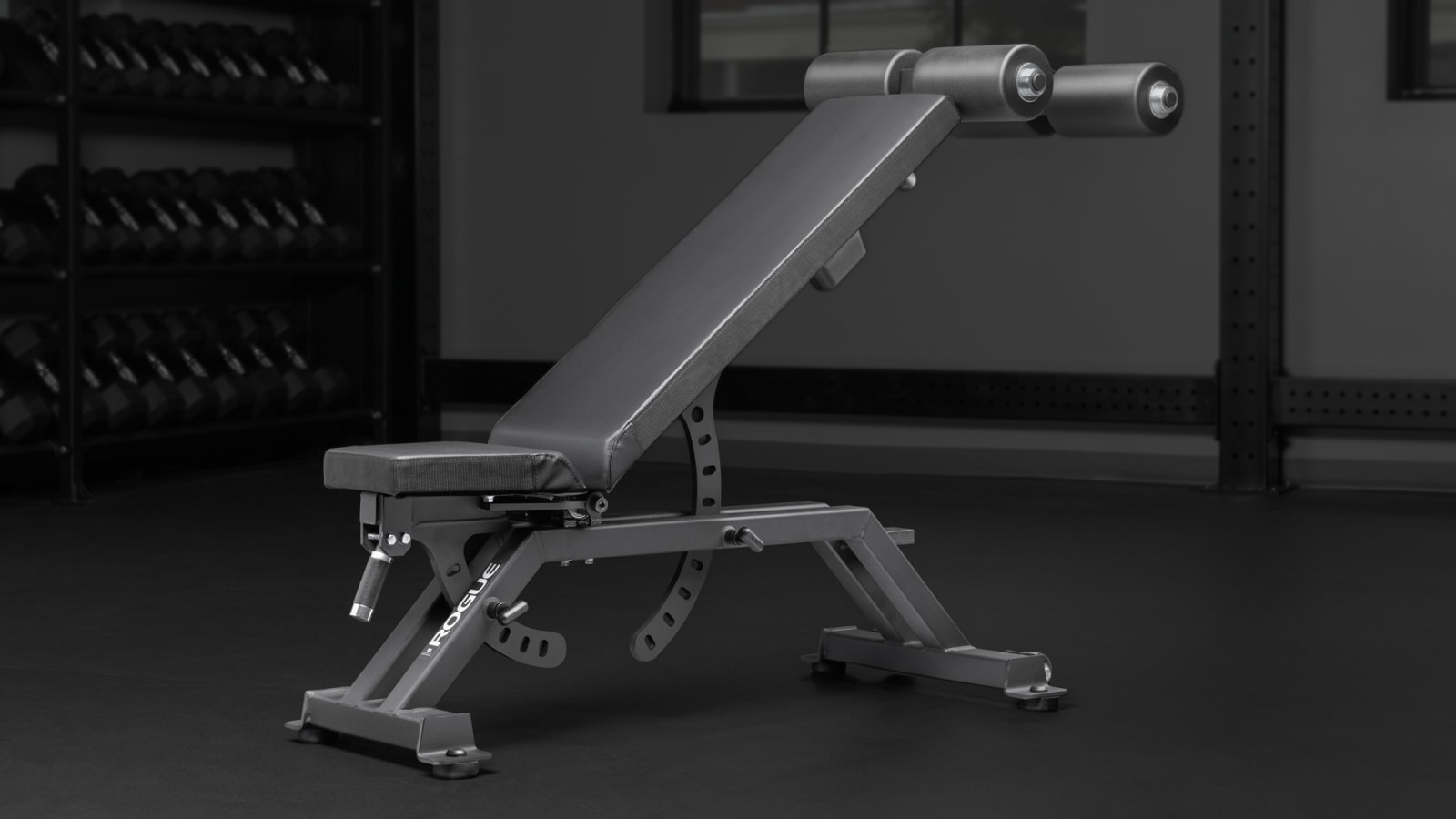
This assessment covers Rogue's current U.S. black AB-3 Adjustable Bench, model/SKU AB3BENCH. It is a standalone adjustable bench, not the AB-2 base package and not merely the separate AB-2 retrofit kit. Rogue describes the AB-3 as the AB-2-style seat-and-back adjustment platform with the additional ability to use the bench in decline. The product page says the removable telescoping foot catch is included standard, and the two-page manual lists one bench and one catch in the included parts. This specific package distinction matters when an included restraint is a hard requirement.
Flat, incline and decline positions
Rogue lists nine back-pad settings from 8 to 78 degrees and six seat positions from -15 to 40 degrees. It describes decline use at each seat position with the foot-catch assembly. Those published ranges support a flat/incline/decline classification, but the page does not list every one of the nine back angles or six seat angles. The claim of more than 50 possible combinations is the maker's description; it should not be converted into an invented angle chart.
The foot catch is a removable telescoping assembly, not an unmentioned add-on. Rogue's instructions say to pull the pop pin, slide the catch into its tube and make sure the pin secures it before use. They also warn users never to sit on the foot catch. That is more useful than a general claim that a bench is “FID”: it clarifies what must be fitted for the intended movements and where a user should not put their weight. The catch should be treated as a separate connection to inspect, not as a seat or step. If an exact retail offer lacks the catch, it is not the included-restraint configuration assessed here.
Read the base and body dimensions separately
Rogue lists the AB-3 at 117 pounds, 68 inches long, 12 inches wide and 18 inches high, with a 51.25-by-22.5-inch footprint. That listed footprint calculates to about 8.01 square feet as a rectangle, just over a strict eight-square-foot maximum. It is not a full exercise envelope. In particular, the page's 68-inch overall length does not become 51.25 inches just because that is one dimension of the listed base; allowance for the longer body, decline use, the catch, a spotter or nearby equipment needs separate planning. Rogue does not publish a square-foot area or a room-clearance recommendation here.
The page identifies 2-by-2-inch and 2-by-3-inch 11-gauge steel, 12-inch pad width, load-bearing rubber feet, a handle and wheels. It describes Cordura edges but does not specify the complete cover or foam construction, pad gap or every material layer. The wheels support repositioning on a suitable surface; the product page does not document an approved upright-storage method, nor does it say that the foot catch stays installed during storage. A buyer with limited floor space should not assume that either the catch-equipped bench or the attached accessory can be stored vertically without checking the exact instructions.
Capacity and other missing specifications
The page's 117-pound figure is the bench's own weight, not its load rating. I found no numerical user-load capacity in the reviewed product specification or descriptive copy, so this assessment does not treat the AB-3 as meeting any requested capacity minimum. “Load-bearing” rubber feet describe the feet; they do not supply a bench rating. The exact individual back and seat angle values, pad gap, pad thickness, storage envelope and accessory clearance also remain unspecified in the reviewed sources. Where one of those details decides whether the bench fits your body, rack or room, contact the maker or inspect the exact unit rather than extrapolating from a product photo.
Where the AB-3 differs from the AB-2
The AB-2 page lists its base as flat-to-incline and offers the RF0708 retrofit separately. The retrofit instructions replace an existing AB-2 spine to create an AB-3 arrangement, so the kit is a conversion part rather than proof that every new or used AB-2 already has decline function. The AB-3's own product identity and included-parts sheet are stronger evidence when the goal is to receive the decline catch with the bench. Conversely, if decline is unnecessary, someone can compare the AB-2's simpler as-listed package without assuming that a catch is included.
The AB-3 may suit a buyer who will use all three positions and values the included catch enough to account for a heavier 117-pound frame and an extra setup check. It is a weaker fit when a numeric capacity is essential, storage must be vertically supported, or a strict eight-square-foot base cap leaves no margin. Before ordering, verify the AB3BENCH model, black configuration and included catch; measure the 68-inch body, base, training and storage clearances separately; and follow the manufacturer's pin and use warnings. This is a document-based comparison, not a claim of ownership or bench testing.
Key specifications
Key details at a glance
| Adjustment range | Flat / incline / decline |
|---|---|
| Bench weight | 117 lb |
| Length | 68 in |
| Width | 12 in |
| Height when flat | 18 in |
| Base footprint area (listed or calculated) | 8.01 sq ft |
| Leg restraint included | Yes |
| Transport wheels shown | Yes |
Use the exact model’s instructions for operating limits, supplied equipment and version differences.
Sources for this review
Sources for this assessment
Compare the constraints that matter to you
Use the finder to compare currently researched benches, and opt in to the five separately assessed earlier REP configurations or families only when checking an existing or used offer. Match the exact model, edition and manual; the catalogue is still being expanded.