
Your needs, this model
Does it fit your priorities?
Can I do decline work without buying another attachment?
Ironmaster lists decline among the Super Bench's positions and says minimal decline is possible without its Crunch Situp attachment, but it recommends that separate attachment to hold the legs. The bench package includes an incline seat, not a leg restraint. If a supplied restraint is essential, this offer does not meet that requirement.
Explore this need in the finder →Why does the capacity rating change with the angle?
Ironmaster's manual says the 1,000-lb maximum includes the user in the flat position and drops to 600 lb when the bench is tilted or the incline seat is used. The library records 600 lb as the conservative minimum across the supported positions rather than treating the flat-only figure as an all-angle rating.
Explore this need in the finder →How much floor room does the bench take, and are transport wheels included?
The current page lists an 18.75-by-41-inch base, about 5.34 square feet before lifting or walking clearance, and a 60-lb bench before adding the seat. The standard Super Bench offer does not list wheels; Ironmaster sells a separate wheel kit. The Kickstand page says the bench can stand vertically, but the kickstand is the part that adds stability and protects the pad in storage.
Explore this need in the finder →Current Ironmaster offer · SKU 1003 · assessed from maker material, not hands-on testing
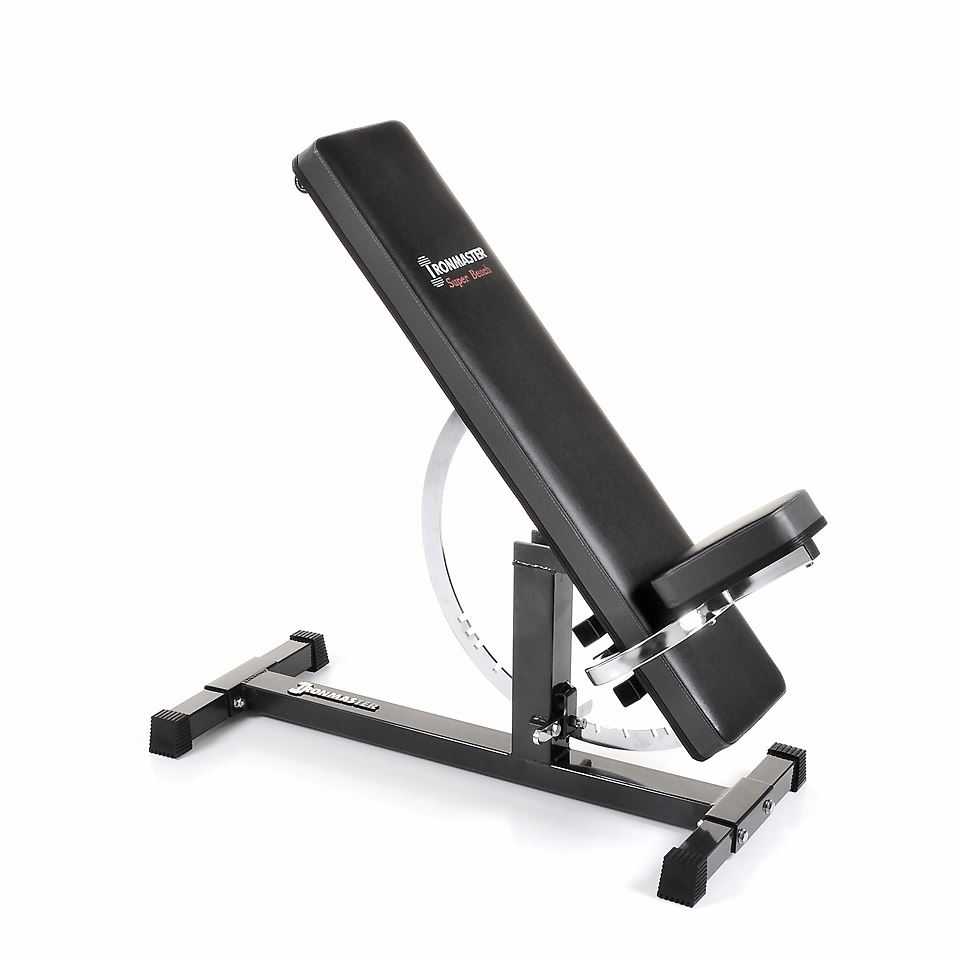
The Super Bench Adjustable Utility Bench is the current standard-model member of Ironmaster’s adjustable bench system. Its useful distinction is not a single angle or a large advertised number: the base offer combines eleven back positions, a removable incline seat, a compact listed floor base and access to a wide attachment family. The cost of that flexibility is model-specific setup and a capacity claim that drops outside the flat position. This assessment is for the current U.S. product-page offer identified as SKU 1003, not every older bench that has ever carried the Super Bench name.
One ring covers flat through upright—and the maker also lists decline
Ironmaster lists eleven lock-out angles—0, 5, 10, 20, 30, 40, 50, 60, 70, 80 and 85 degrees—and describes the bench as usable flat, inclined, declined and upright. The included seat plugs in from the side at three positions. That gives the seat a purpose beyond filling the gap: the maker says it moves with the back pad so the two stay perpendicular, and can be removed when a larger continuous pad is wanted. Those are useful configuration details to compare with a conventional ladder-adjustable bench, but they are manufacturer descriptions rather than observations from our own workouts.
Decline needs a separate judgment from “the back moves.” Ironmaster says minimal decline is possible without an attachment and recommends the separate Crunch Situp attachment to hold the legs. That part is not the standard bench package. A buyer who needs a restraint supplied with the bench should not treat the listed decline position as proof of one; a buyer willing to source a compatible add-on should verify the exact fit and assembly directions first.
Read the two capacity figures as two different operating conditions
The current product page says 1,000 lb in the flat position and 600 lb when the bench is tilted or the incline seat is used. The linked Super Bench assembly and operating manual says those maxima include the user. This is not an independent load test, and it is not a 1,000-lb rating at every angle. To keep the finder from implying that the larger flat-only figure applies to all positions, this library uses 600 lb as the conservative minimum across the documented range. If your specific plan depends on a limit at a particular angle, confirm Ironmaster’s interpretation for the exact unit rather than transferring the flat claim.
The manual also makes correct engagement of the locking lever a condition of use: the lever must seat fully in a ring notch. That is a practical point to check after assembly and each angle change. Ironmaster describes the product as largely assembled apart from its feet, but the person setting it up still needs the appropriate tools and a level surface. The posted manual is titled for the Super Bench family and is dated 2015; because the current page links it, it is relevant family evidence, but the document does not establish every later hardware revision or every accessory’s fit.
A relatively small base is not the same as a small training zone
For the current listing, Ironmaster gives a 44-inch length, 18.75-inch width, 20-inch flat height and an 18.75-by-41-inch footprint. The base rectangle works out to about 5.34 square feet. That is a useful comparison number, not a room plan: it excludes space to get onto the bench, move weights, access a rack, stand the unit upright or move it through a doorway. The listing gives a 60-lb bench weight before the included incline seat brings the assembly to 65 lb, so a compact outline does not make it a featherweight object.
Ironmaster says its Super Bench models stand vertically; the compatible Kickstand is sold separately to make storage more stable and protect the pad. The standard SKU 1003 page does not list wheels in the package. Ironmaster offers a distinct Wheel Kit for the non-PRO Super Bench, so do not assume that a photograph or a retailer bundle includes it. The bench’s ability to stand upright and its optional rolling hardware solve different storage problems.
Attachment range brings compatibility checks with it
The receiver is the start of a small equipment system, not a claim that all add-ons arrive with the bench. Ironmaster lists separate dip handles, a chin-up bar, a preacher pad, leg attachment, cable equipment and other pieces. The brand itself separates the standard Super Bench leg attachment from the PRO-only version, and some current accessories require specific receiver or Cable Tower arrangements. That is a real advantage for an owner building a compatible setup, but a purchase plan should name the bench generation and every attachment SKU; a generic “fits Super Bench” assumption is not a safe substitute for the maker’s compatibility notes.
Compared with the current Super Bench PRO V2 assessment, this SKU sits higher when flat, has a standard-width 3-inch pad rather than the PRO V2’s lower dual-width pad, and does not include transport wheels and handle as standard. Both listings show an eleven-position design and the same 1,000/600-lb distinction, and both need a separate restraint for a more secure decline arrangement. The PRO V2’s maker-listed base envelope is wider and longer, while this original listing has the smaller stated base rectangle. Those distinctions are more useful than calling one a universal upgrade.
Who should shortlist it: a home lifter who values an included adjustable seat, upright storage and a broad angle range in a compact base, and is comfortable confirming accessory generations and moving a 60–65-lb bench. Who should pause: anyone who requires an included decline restraint, wheels in the base package, or a 1,000-lb claim in tilted positions. The source record is a researched specification assessment, not a recommendation based on ownership or testing.
Key specifications
Key details at a glance
| Adjustment range | Flat / incline / decline |
|---|---|
| Manufacturer-stated capacity | 600 lb |
| Bench weight | 60 lb |
| Length | 44 in |
| Width | 18.75 in |
| Height when flat | 20 in |
| Base footprint area (listed or calculated) | 5.34 sq ft |
| Back-pad positions | 0 / 5 / 10 / 20 / 30 / 40 / 50 / 60 / 70 / 80 / 85° |
| Leg restraint included | No |
| Vertical storage supported | Yes |
| Transport wheels shown | No |
Use the exact model’s instructions for operating limits, supplied equipment and version differences.
Sources for this review
Sources for this assessment
- Super Bench Adjustable Utility Bench — Ironmaster
- Super Bench Adjustable Utility Bench product data — Ironmaster
- Assembly & Operating Instructions: Ironmaster Super Bench
- Kickstand for Super Bench/PRO — Ironmaster
- Wheel Kit - Super Bench (not PRO model) — Ironmaster
- Crunch Situp Att for Super Bench/PRO — Ironmaster
- Adjustable Weight Benches & Attachments — Ironmaster
- CPSC recall database query for Ironmaster
Compare the constraints that matter to you
Use the finder to compare currently researched benches, and opt in to the five separately assessed earlier REP configurations or families only when checking an existing or used offer. Match the exact model, edition and manual; the catalogue is still being expanded.