
Your needs, this model
Does it fit your priorities?
Can I store the Super Bench PRO V2 upright and roll it out again?
Yes. Ironmaster says the PRO V2 stands vertically, and its current base offer includes wheels on one foot plus a handle on the other. The 65-lb frame is not weightless, and the company sells an optional kickstand to make vertical storage more stable and protect the pad; check the room and floor before treating this as effortless storage.
Explore this need in the finder →Does the lower flat profile keep the full 1,000-lb rating at every angle?
No. Ironmaster's manual says the 1,000-lb maximum includes the user in the flat position and 600 lb when tilted or using the incline seat. The site uses 600 lb as its conservative minimum for matching across the position range and does not treat the flat-only claim as an all-angle rating.
Explore this need in the finder →Does a decline setting mean that a leg restraint comes in the box?
No. The PRO V2 has listed decline angles and Ironmaster says minimal decline is possible without another part, but the company recommends its separate Crunch Situp attachment to hold the legs. The current bench SKU is the bench and included incline seat; the Crunch attachment is a distinct offer.
Explore this need in the finder →Current Ironmaster offer · SKU 1001 · assessed from maker material, not hands-on testing
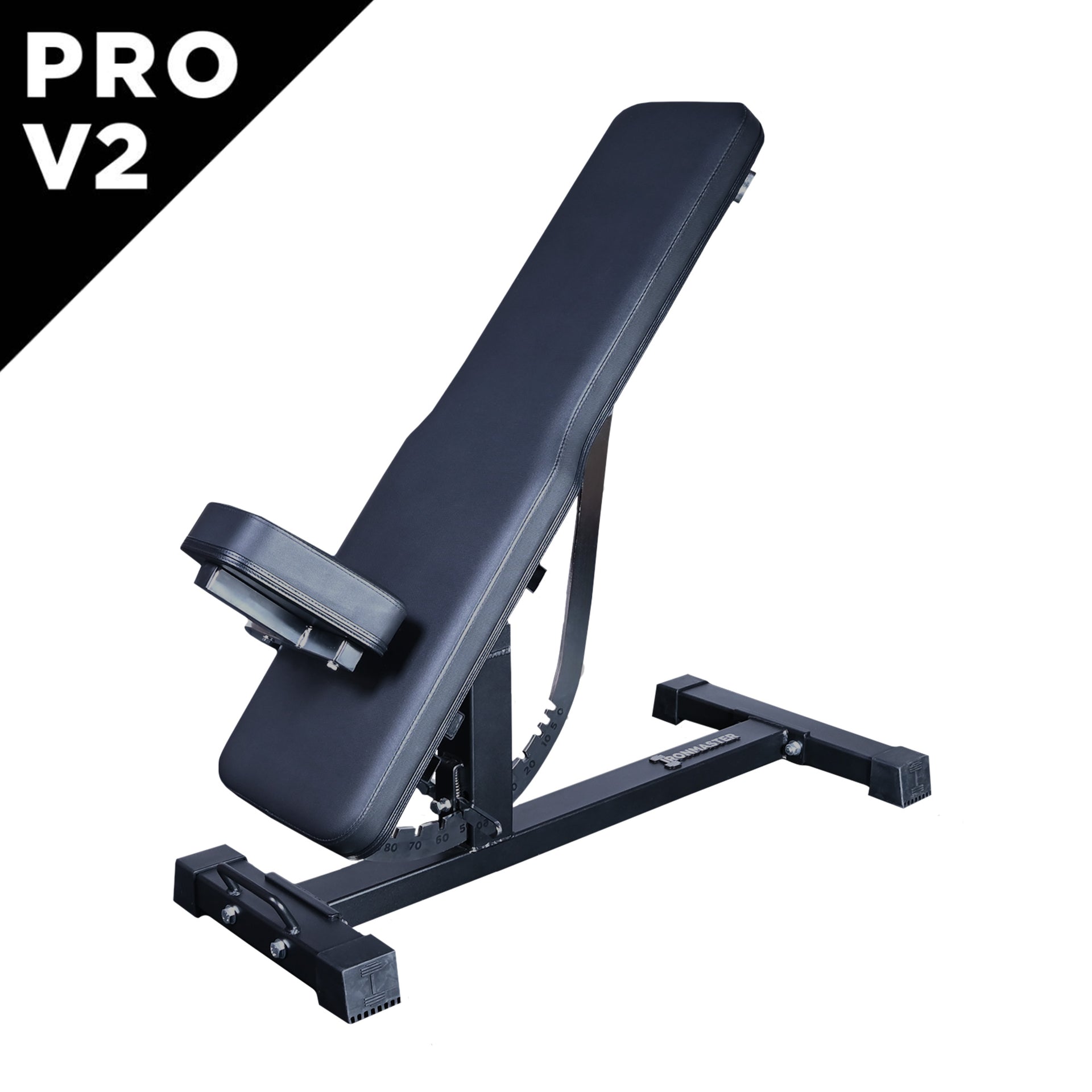
The Super Bench PRO V2 is a distinct current offer, not a finish variation of the standard Super Bench. Ironmaster identifies it as SKU 1001 and documents several practical changes: a lower flat height, dual-width pad, integrated handle, and wheels supplied with the base bench. It keeps the family’s lever-and-ring adjustment and add-on receiver, while its stated capacity still changes with position. The assessment below concerns the current U.S. bench-and-incline-seat package, not a Cable Tower bundle or a separate restraint attachment.
Angle range is broad, but decline restraint is not included
The PRO V2’s eleven listed positions are 0, 5, 10, 20, 30, 40, 50, 60, 70, 80 and 85 degrees. Ironmaster describes flat, incline, decline and upright uses and includes a three-position incline seat. The seat plugs in from the side, can be adjusted for height, and can be removed to leave a longer continuous pad. The page says it moves with the backrest so the two pads remain perpendicular. Those details make the package more configurable than a simple backrest-only design, but they do not tell us whether a particular lifter will find the seat shape comfortable.
There is an important boundary around the word “decline.” Ironmaster says minimal decline can be achieved without another part, but recommends the separately sold Crunch Situp attachment to help hold the legs. The PRO V2 product feed lists a single default bench SKU, 1001; the Crunch item is a separate SKU family, not a hidden standard inclusion. If an included restraint is a hard requirement, this offer does not satisfy that condition as assessed. If you plan to add one, check the maker’s exact instructions and compatibility rather than treating the receiver as universal.
Its rating depends on how the bench is set
Ironmaster states a maximum of 1,000 lb in the flat position and 600 lb in incline and upright positions. The linked PRO V2 manual specifies that the maximum includes the user; it also describes the eleven-position ring and included seat. These are maker limits, not a test we performed. For transparent matching across the bench’s documented range, the library uses 600 lb as the conservative capacity floor, while the review preserves the higher flat-only figure. A 1,000-lb flat line should not be read as permission to carry that load while tilted.
The manual’s operating note is specific: the locking lever needs to be fully seated in a ring position before use. That is the most important setup check to carry forward after any adjustment. The page says the unit is preassembled except for the feet; assembly still requires basic tools and the maker directs users to verify the lock. Its latch-based receiver also matters when an attachment is fitted: the manual and accessory pages describe a pull pin and threaded tightening knob, so an add-on is not simply dropped into place and forgotten.
A lower flat height with a dual-width contact surface
Ironmaster lists a 17.2-inch flat height, an overall length of 47 inches and a 12.5-inch narrow foot plus a 21-inch wider foot. A conservative rectangular envelope using the longest dimension and widest foot is about 6.85 square feet; the supports do not fill that entire rectangle, and it is not working clearance. The base is therefore not directly comparable to a maker’s stated continuous-area footprint without reading the measurement method. The listing gives a 65-lb bench without the incline seat and 69 lb with it. Its lower profile may matter to lifters comparing bench height, while the mass and upright storage position still require a clear, stable place to move the bench.
The 44-inch back pad is listed as 10.25 inches across one zone and 12.25 inches across another, with a 2.5-inch pad thickness. This is a deliberate compromise between a standard-width contact area and broader shoulder support; the maker says the pad is double-width rather than selling the two sizes as separate bench SKUs. It should be assessed as one current configuration. Check that the exact offer is still the PRO V2 model and that a replacement pad or an older PRO bench is not being substituted in a marketplace listing.
Wheels and upright storage are different benefits
Unlike the standard Super Bench listing, the PRO V2 includes wheels on one foot and a handle on the other. Ironmaster says it can stand vertically and that the optional Kickstand adds stability in that storage position while protecting the pad. Wheels help with tilting and rolling; they do not mean the bench folds, and a stand-up position still needs a suitable floor and enough overhead or wall clearance. A second wheel kit is an extra, not part of the one-wheel-end base configuration.
The attachment system is useful if the buyer is building around Ironmaster gear. The company documents broad compatibility for many accessories, but also warns that not every earlier Super Bench part fits every PRO generation. The PRO V2 product page specifically identifies its PRO-only leg attachment and notes that current Cable Tower stock includes an adapter that some older towers may lack. Those are package checks, not minor shopping trivia: name the bench SKU and the attachment generation before combining them.
Who should shortlist it: someone who wants a compact bench with wheels, a handle, vertical storage, an included seat and a dual-width pad, and whose required capacity is within the documented rating for the intended angle. Who should look elsewhere: someone who needs a restraint included for decline, a documented rating of at least 1,000 lb while tilted, or an attachment package that is already proven to fit older Ironmaster equipment. This is a source-based assessment; we have not assembled, owned or tested the bench.
Key specifications
Key details at a glance
| Adjustment range | Flat / incline / decline |
|---|---|
| Manufacturer-stated capacity | 600 lb |
| Bench weight | 65 lb |
| Length | 47 in |
| Width | 21 in |
| Height when flat | 17.2 in |
| Base footprint area (listed or calculated) | 6.85 sq ft |
| Back-pad positions | 0 / 5 / 10 / 20 / 30 / 40 / 50 / 60 / 70 / 80 / 85° |
| Leg restraint included | No |
| Vertical storage supported | Yes |
| Transport wheels shown | Yes |
Use the exact model’s instructions for operating limits, supplied equipment and version differences.
Sources for this review
Sources for this assessment
Compare the constraints that matter to you
Use the finder to compare currently researched benches, and opt in to the five separately assessed earlier REP configurations or families only when checking an existing or used offer. Match the exact model, edition and manual; the catalogue is still being expanded.