
Your needs, this model
Does it fit your priorities?
Does this bench document decline as well as flat and incline?
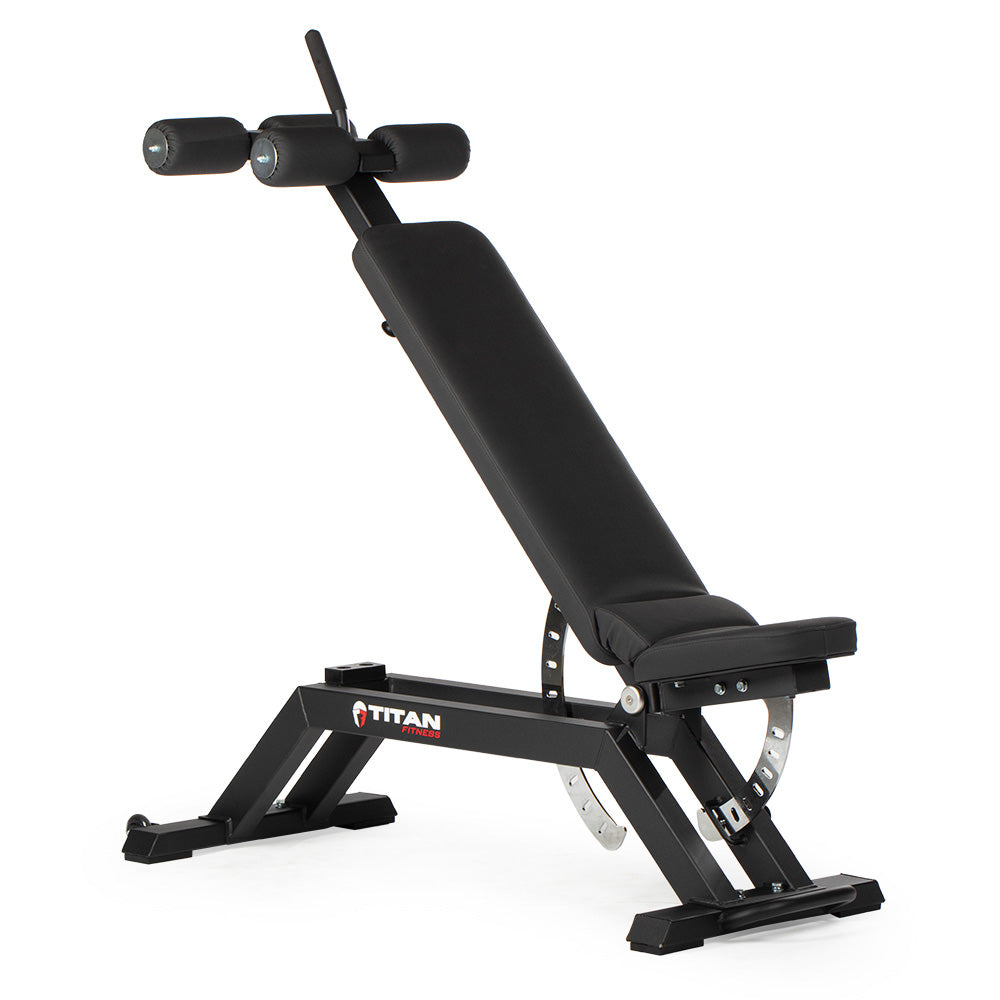
Yes. Titan calls SKU 400554 an FID bench, lists a negative 20-degree decline and says the back/seat can be set flat, inclined, upright or declined. It gives ten bench positions and seven head/seat positions, but not a complete angle chart. The included removable foot rollers are support for decline sit-ups, not a belt restraint or guarantee of fit.
Explore this need in the finder →What capacity does Titan publish for SKU 400554?
Titan lists 600 lb. The page does not clarify whether that convention includes user weight, and this assessment does not test or certify the rating. Compare it with the different 500-lb incline figure for the Elite FID and the 650-lb any-angle claim for the Performance Series; those are distinct maker statements, not comparable tests.
Explore this need in the finder →Does it roll away, and is upright storage confirmed?
Titan lists rear transport wheels and a front handle, so a wheel-required finder result is supported. The reviewed page does not describe upright storage. Do not use the wheels, handle or the 70-by-23.5-inch overall dimensions as proof that standing the assembled bench vertically is an approved storage position.
Explore this need in the finder →Current Titan Fitness U.S. offer · SKU 400554 · reviewed from manufacturer material, not hands-on testing
The TITAN Series Adjustable FID Bench is the Titan option in this group that explicitly documents decline as well as flat and incline positions. It is also a 92-lb bench with a 600-lb manufacturer-stated rating, removable foot rollers and wheels. The useful distinction is not simply that it has many settings: the page gives a broad count of ten bench positions and seven head/seat positions, but no complete angle chart or load explanation. This is a source-based assessment, not a test report.
Decline is documented; the full angle ladder is not
Titan calls SKU 400554 an FID bench and states that it can be set flat, inclined, upright or declined. It specifically identifies a negative 20-degree decline. Those statements support a flat/incline/decline match. Titan separately says there are ten bench positions and seven head/seat positions, with up to 70 customizable options. The product page does not enumerate every angle or show how every back and seat setting pairs. Treat the position count as a count, not proof of 70 different back-pad angles or an angle interval that Titan never publishes.
The seven-position upper pad and the 36-by-11-inch bench pad make the adjustment scheme worth checking against the movements and body dimensions that matter to you. Titan lists a 13.5-inch head/seat pad whose width varies from 8 to 11 inches, plus a 5.5-by-11-inch section it labels “Gap Pad.” I do not relabel that number as a measured physical gap: the page describes a separate pad dimension, not a clear gap specification. Read the exact product page and manual together, and ask the manufacturer if a particular pad transition is a deciding fit issue.
Foot rollers are not the same thing as every kind of restraint
The supplied package includes a removable foot-roller attachment. Titan describes those rollers for decline sit-ups, and the 400554 operator manual lists a leg frame, foam tubes and four foam pieces. That is a meaningful included support for a decline-focused routine, so it is included in the finder’s broad “include it with the bench” filter. It should not be mistaken for a belt, ankle strap or guaranteed fit for every user. Confirm how the rollers are installed and used from the current instructions; the product page calls them removable, so verify the exact parts in the box rather than assuming a component shown in a general photo is bundled with a particular seller offer.
Keep the maker rating in its lane
Titan lists 600 lb for this model. The page does not explain whether that number includes the user, and our library has not load-tested the bench. On this FID offer the published 600-lb number is the field used for a whole-range comparison. That is deliberately different from Titan’s Elite FID listing, which separates a 1,000-lb flat statement from a 500-lb incline figure, and from the Performance Series page, which says 650 lb at any angle. These are separate maker claims with different scope, not a cross-brand performance test. If your combined user-and-implement load is close to a published limit, get Titan’s written interpretation for the exact SKU and position before relying on it.
The page lists a 70-by-23.5-by-17.25-inch overall envelope and 92-lb product weight. It describes an 11-gauge, double-frame steel construction and HeftyGrip vinyl. No numeric training-base area is given, and overall dimensions do not show the floor-contact outline or exercise clearance. The listed front handle and rear wheels help identify a way to move the bench on a suitable surface, but the page does not say that the assembled unit may be parked vertically. We therefore leave both the training-area and upright-storage fields unconfirmed. A 70-inch length is also not a rack-fit guarantee; check rack uprights, foot clearance, the loaded bar path and the doorway route separately.
How it differs from Titan’s other adjustable benches
The 400554 FID has a distinct identity from the reviewed Elite Series Adjustable FID Bench (SKU 401912) and the TITAN Series Adjustable Bench (SKU 401849). The Elite FID is the other reviewed Titan model with decline and an included foot-anchor assembly, but Titan publishes a 500-lb incline rating there. The 401849 TITAN Series model is a flat-to-incline bench with 1,000 lb flat and 600 lb angled, and its product page describes upright storage. The Performance Series is listed at 650 lb at any angle but does not document decline. Choose by the exact position and package requirements, not by treating the shared brand name as a shared frame or feature set.
Who may shortlist it: a buyer who needs a documented decline position, wants included removable foot rollers and transport wheels, and is comfortable evaluating a 600-lb manufacturer figure. Who should pause: anyone who needs the full back/seat angle schedule, a confirmed upright storage position, a numeric use footprint, a different load convention or a fixed rather than adjustable platform. Confirm SKU 400554, current assembly instructions, the supplied roller hardware, rating interpretation, room clearance and seller package before choosing it.
Key specifications
Key details at a glance
| Adjustment range | Flat / incline / decline |
|---|---|
| Manufacturer-stated capacity | 600 lb |
| Bench weight | 92 lb |
| Length | 70 in |
| Width | 23.5 in |
| Leg restraint included | Yes |
| Transport wheels shown | Yes |
Use the exact model’s instructions for operating limits, supplied equipment and version differences.
Sources for this review
Sources for this assessment
Compare the constraints that matter to you
Use the finder to compare currently researched benches, and opt in to the five separately assessed earlier REP configurations or families only when checking an existing or used offer. Match the exact model, edition and manual; the catalogue is still being expanded.