
Your needs, this model
Does it fit your priorities?
Does this model include a decline setting or restraint?
Titan describes the supported positions as flat, incline and upright; the nine listed back angles contain no negative decline angle. The product page and linked manual do not list an included decline-restraint assembly. This is a flat-to-incline model in the reviewed current offer, not an FID bench.
Explore this need in the finder →Which rating applies when the bench is inclined?
Titan states 1,000 lb flat and 600 lb when inclined. The same product page separately gives nine explicit back angles through 85 degrees but elsewhere says 'up to' 86 degrees. Treat 600 lb as the lower published figure, not as a test or a claim that the page establishes a load limit at every angle.
Explore this need in the finder →Does its upright storage claim describe the amount of floor space needed while training?
No. Titan lists a 24.75-by-17-inch footprint for upright storage and gives 56.5 by 24.75 inches as overall dimensions. It does not give the bench's training-base area, so this page does not receive a numeric base-area match. Measure exercise clearance and the vertical storage area separately.
Explore this need in the finder →Current Titan Fitness U.S. offer · SKU 401849 family · assessed from manufacturer material, not hands-on testing
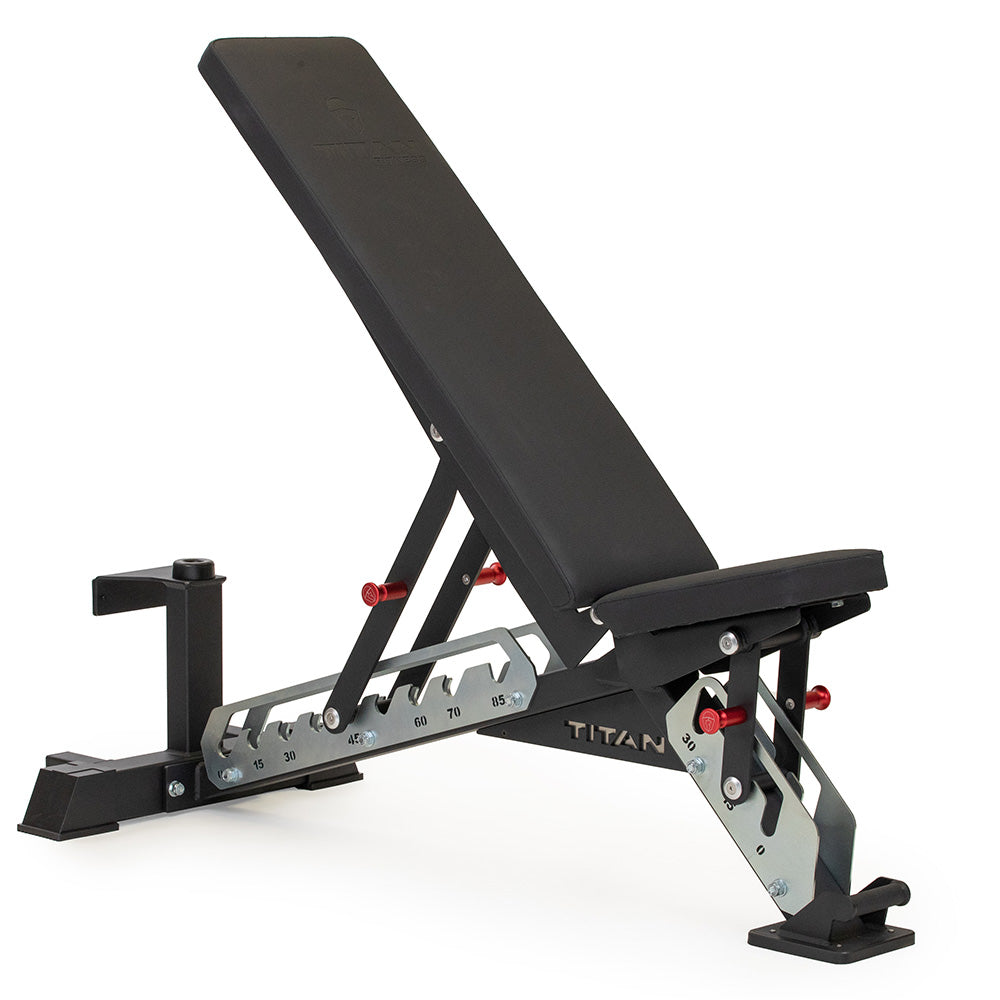
The TITAN Series Adjustable Bench is the heaviest of the three current Titan adjustable benches assessed here. It pairs a 40-inch back pad and nine explicitly listed back angles with rear wheels and upright storage, but it is a flat-to-incline bench—not an FID model. Its published capacity also depends on position: Titan lists 1,000 lb flat and 600 lb angled. This is a maker-specification review, not a hands-on or load-test report.
Long back pad and a numbered adjustment ladder
The product page enumerates nine back settings: 0°, 15°, 30°, 38°, 45°, 55°, 60°, 70° and 85°, plus three seat settings at 0°, 15° and 30°. Another Titan bullet says the nine back positions reach 86°. Because those two statements conflict, this review preserves the explicit nine-angle list and does not present 86° as a separately verified setting. The linked operator manual identifies the TITAN Series Adjustable Bench and SKU 401849.
Titan describes flat, incline and upright positions; the page does not document a negative decline angle or an included leg-restraint assembly. This is a meaningful distinction from the Elite Series FID, which lists foam foot anchors, and from both models’ package-specific movement hardware. Check the exact product name and supplied components rather than treating the word “adjustable” as proof of decline capability.
Separate the flat rating from the inclined rating
Titan lists 1,000 lb flat and 600 lb angled. The page does not assign a separate rating to every listed angle or clarify whether the stated capacities include the user. The finder uses 600 lb as the lower published cross-position figure; it does not imply the 1,000-lb flat figure applies when inclined. Neither statement is an independent load test. Confirm the maker’s interpretation for the exact position and load you intend to use.
The bench is listed at 120 lb, with a 56.5-by-24.75-inch overall size and a 17-inch flat height. The back pad is 40 by 12 inches; the seat is 12 by 12 inches; both are 2.5 inches thick. Titan describes a 2-by-3-inch, 11-gauge frame and HeftyGrip vinyl. Its longer listed back pad distinguishes it from the Performance Series’ 34-inch pad, while the seat is narrower than the Elite FID’s 15-inch seat. These are dimensional comparisons only, not fit or comfort conclusions.
Upright storage is not the training footprint
Titan lists heavy-duty wheels, a knurled handle, rubber feet and upright storage. It gives an upright-storage footprint of 24.75 by 17 inches, which describes that storage position only. The product page does not give a training-base area; neither this storage envelope nor the overall length and width can responsibly stand in for the floor area occupied during exercise. Measure the room, rack access, clearance and storage route separately.
Compared with the Performance Series, the TITAN Series is listed 68 lb heavier, carries a 600-lb angled figure rather than 650 lb “at any angle,” and has the longer back pad. Compared with the Elite FID, it forgoes the documented decline/foot-anchor package but lists a higher angled figure and a separate 1,000-lb flat rating. These are product-page distinctions, not results of a direct test.
Who may shortlist it: someone seeking flat-to-incline adjustment, a long back pad, wheels and a maker-described upright-storage option, and who is comfortable with a 120-lb listed bench. Who should pause: a buyer who needs decline, wants to treat 1,000 lb as the inclined rating, or needs a training-base area. Confirm the product revision, angle instructions, storage clearance and rating interpretation before purchase.
Key specifications
Key details at a glance
| Adjustment range | Flat / incline |
|---|---|
| Manufacturer-stated capacity | 600 lb |
| Bench weight | 120 lb |
| Length | 56.5 in |
| Width | 24.75 in |
| Height when flat | 17 in |
| Back-pad positions | 0 / 15 / 30 / 38 / 45 / 55 / 60 / 70 / 85° |
| Seat-pad positions | 0 / 15 / 30° |
| Leg restraint included | No |
| Vertical storage supported | Yes |
| Transport wheels shown | Yes |
Use the exact model’s instructions for operating limits, supplied equipment and version differences.
Sources for this review
Sources for this assessment
Compare the constraints that matter to you
Use the finder to compare currently researched benches, and opt in to the five separately assessed earlier REP configurations or families only when checking an existing or used offer. Match the exact model, edition and manual; the catalogue is still being expanded.