
Your needs, this model
Does it fit your priorities?
Is this a conventional flat bench or adjustable FID bench?
No. Titan describes a fixed seated bench with a slightly angled backrest. It gives no flat, incline or decline angle list and no backrest adjustment range, so it should be compared as a specialty seated platform rather than as a general weight bench.
Explore this need in the finder →Does its 330-lb maker rating clear the finder’s 325-lb minimum step?
Yes, the listing’s 330-lb claim is above the questionnaire’s 325-lb step. The finder accepts 25-lb increments, so it does not offer 330 as an input; the next step is 350 lb, at which this listed rating no longer meets the minimum. Titan does not clarify whether user bodyweight is included.
Explore this need in the finder →Can it be moved, and is upright storage confirmed?
Titan lists a front handle and rear wheels, so a wheels-required search can include this offer. Its page does not describe upright storage; do not infer that the bench can stand vertically from its wheels or handle.
Explore this need in the finder →Current Titan Fitness U.S. offer · SKU 420048 · assessed from manufacturer material, not hands-on testing
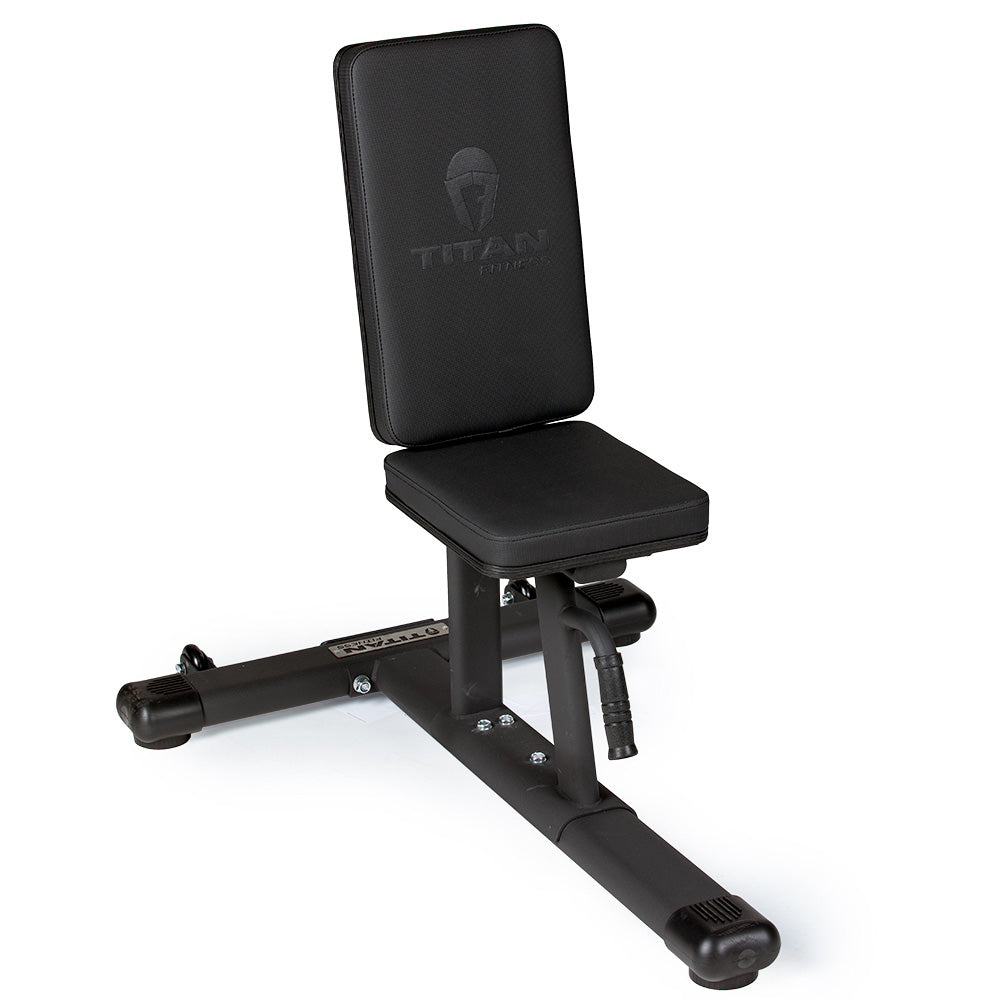
The Titan Seated Stationary Bench is a fixed seat-and-back platform intended for seated strength work. That makes it a legitimate specialty bench to consider in its own lane, but not a substitute for a flat utility or adjustable FID bench. Titan describes seated chest presses, dumbbell rows, triceps extensions and isolation work; it says the backrest is slightly angled, without providing an angle or an adjustment range. The separate seat pad, upright back pad and simple base are visible in the official product image. Its product page identifies a one-option U.S. offer, SKU 420048.
A set seated position rather than an angle ladder
The main buying question is whether a fixed seated posture fits the movements you want to do. Titan lists an 18-inch seat height, a 19-by-11.25-inch back pad and an 11.5-by-11.25-inch seat pad. The overall dimensions are 30 inches wide, 43 inches deep and 37 inches high. Those details describe the product envelope and contact surfaces, but do not establish how the fixed back angle will align with a particular person's torso or a chosen exercise. Because the source gives no angle measurement, this assessment does not call the backrest upright, incline or flat in the questionnaire's general-bench sense.
That distinction matters when comparing it with a normal bench. The finder asks whether a flat position, incline or decline is required; this model is not placed in those sets because Titan does not document those adjustable training positions. It also does not document an included decline restraint. A fixed seat and back can be useful for a narrower seated routine, but the maker's phrase “slightly angled” does not tell a buyer the angle, seat-to-back relationship or compatibility with every press technique. Inspect the exact product and ask the manufacturer for movement-specific guidance if alignment is critical.
Capacity and transport are documented, storage is not
Titan states a 330-pound weight capacity and a 38-pound product weight. The product page does not define whether user bodyweight is included in the capacity. Treat 330 pounds as the maker's published claim, not an independent test or a universal promise for any exercise. Confirm how the rating applies to the intended user and equipment, and follow the exact assembly and use instructions. The linked manual route was not available in the saved research: its first access redirected to a Titan Support page and returned a 403 response, so assembly and maintenance directions are not reconstructed from the product photo.
The listing calls the base low-clearance and says rubber feet protect the floor. It also lists a front handle and rear wheels for repositioning. That supports a wheels-required finder match; it does not establish that the bench folds or stores upright. Titan's page says it can be moved and stored between sessions, but it provides no vertical-storage instruction or stored-position footprint. The separate training-base area is likewise not published. The overall length and width are useful room-planning references, but should not be converted into a square-foot base score or mistaken for the clearance needed to bring weights into position.
Where this specialty bench differs from a preacher station
The Preacher Curl Station and Preacher Curl Bench V3 are designed around an angled arm pad and bar support for curling; this Seated Stationary Bench is designed around a fixed seat-and-back position. Its page lists no preacher arm pad, bar catch or J-hook. Conversely, the curl stations do not document the Seated Bench's claimed rear wheels. These are three separate movement arrangements in Titan's current parent collection, not three finish options for one generic bench. Compare the product name and SKU before treating a listing, photo or manual as the one you researched.
For a general chest-press setup that needs a flat pad, or a routine that changes back angle between flat and incline, the current evidence does not establish this bench as the right tool. The same caution applies if vertical storage is essential, if a known base area is required, or if you need to know the exact backrest angle before ordering. Nothing in this assessment claims that the seating position has been personally tested or measured.
Practical checks before a shortlist decision
Confirm that the product is SKU 420048 and that the offer includes the complete fixed bench, not a replacement pad or a different seated machine. Measure doorways, floor space and the approach to the bench; the page lists 30-by-43-inch overall width and depth, but does not provide an operating-clearance drawing. Check whether the manufacturer can clarify the fixed back angle, exercises covered by the capacity statement, and whether its intended stored position is upright or only repositioned on the wheels. Verify the current manual, assembly requirements and seller terms before purchasing.
Who may shortlist it: someone specifically looking for a standalone seated bench for supported dumbbell or barbell movements who values the listed wheels and can assess the fixed angle in person or with Titan's guidance. Who should pause: a shopper who needs a conventional flat bench, an angle-adjustable FID model, vertical storage, exact footprint data or a capacity definition that the current product page does not provide.
Key specifications
Key details at a glance
| Adjustment range | Specialty fixed seated bench |
|---|---|
| Manufacturer-stated capacity | 330 lb |
| Bench weight | 38 lb |
| Length | 43 in |
| Width | 30 in |
| Leg restraint included | No |
| Transport wheels shown | Yes |
Use the exact model’s instructions for operating limits, supplied equipment and version differences.
Sources for this review
Sources for this assessment
Compare the constraints that matter to you
Use the finder to compare currently researched benches, and opt in to the five separately assessed earlier REP configurations or families only when checking an existing or used offer. Match the exact model, edition and manual; the catalogue is still being expanded.