
Your needs, this model
Does it fit your priorities?
Does this Manta Ray configuration include its Foot Catch?
No. The no-catch RF0983 variants omit the optional Manta Ray Foot Catch; catch variants end in -FC. Rogue’s manual says the catch is not included unless it was purchased at checkout.
Explore this need in the finder →Does the selected finish change the Manta Ray pad?
Yes. Rogue describes Textured Black as a lower-priced build with premium textured foam and a round molded handle; the nine medium-gloss frame colorways use grabber-style vinyl and a machined-aluminum handle. Check the exact RF0983 finish SKU.
Explore this need in the finder →Will the Manta Ray fit under a 10-square-foot base-area limit?
The no-catch base dimensions are 57 by 24.75 inches, which form an about 9.80-square-foot rectangle. It is calculated from linear dimensions and excludes clearance. The catch-installed footprint is undocumented, so the value cannot be applied to that package.
Explore this need in the finder →Short version: The Rogue Manta Ray is a 140-pound adjustable bench with a 3-by-4-inch, 7-gauge frame, an internal ladder and five seat positions. This assessment covers a Manta Ray without its optional foot catch. The ten back settings span flat, incline and decline; the base package does not include the optional restraint. Rogue does not state a capacity rating on the product page reviewed here. The article is based on maker documentation, not hands-on testing.
Ten back positions and five seat positions
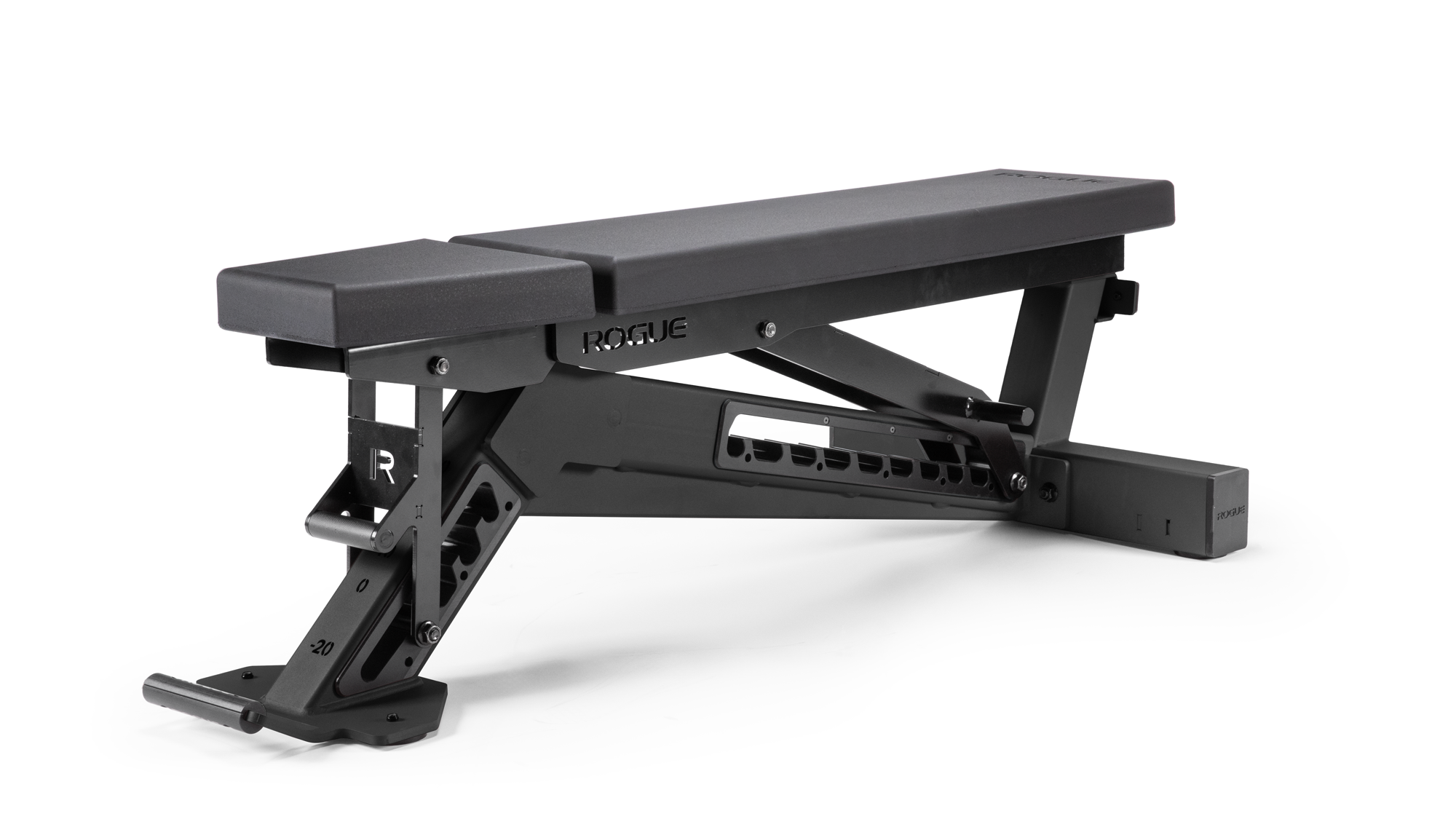
Rogue lists ten back-pad positions from 0° through 85° and five seat settings at -20°, 0°, 10°, 20° and 30°. The manufacturer says the combination creates 50 potential configurations. The negative seat setting is part of the bench’s decline arrangement; the documented back-position list begins at flat. Rogue presents the Manta Ray as an incline/decline/flat bench, but this no-catch configuration does not include a foot restraint.
The bench uses an internal ladder-style adjustment system inside the frame tube. Rogue describes the design as having fewer exposed components than its Adjustable Bench 3.0 and identifies laser-cut angle markings. That is a design description rather than a test of how quickly or quietly the system adjusts. The 3.0 product page also has an unresolved edition/SKU naming bridge in this research: most current RF0959 variant names identify a 3.1 despite the page title saying 3.0. This review therefore remains tied to the Manta Ray’s own RF0983 family rather than inheriting 3.0-specific seller claims.
Different Manta Ray finish builds are not only colors
The current Manta Ray selector and its embedded ProductGroup expose ten no-catch model SKUs and ten matching catch SKUs. Nine of the no-catch color options use a medium-gloss frame finish and a grabber-style vinyl pad; the Textured Black SKU is a separate lower-priced build with the premium textured foam pad and round injection-molded handle. Rogue’s narrative product copy also says “11 colorways,” but an eleventh current RF0983 SKU was not present in the captured selector/ProductGroup, so this assessment does not invent or count one. A review image showing Textured Black should not be read as proof that every color uses the same pad surface or handle. If pad material or grip feel matters, verify the finish SKU, not just the Manta Ray model name.
The Manta Ray’s listed pad is 12 inches wide and 52 inches long with about a one-inch gap. The maker lists 17.5 inches flat and 56 inches at the 85-degree setting. The pad’s width and gap support a meaningful paper comparison with narrower benches, but do not establish fit for an individual’s shoulders, preferred arch or training style. Frame material is listed as 3-by-4-inch, 7-gauge steel. Rogue describes a broad, manta-shaped front foot and caster wheels; statements about stability and smoother movement remain maker claims, not measurements performed for this review.
Room and storage planning
Rogue gives the Manta Ray a 57-inch base length and 24.75-inch rear-foot width, along with a 140-pound unit weight. Multiplying the listed length and rear-foot width and converting to square feet gives about 9.80 square feet. That is our rectangular calculation from the manufacturer’s linear dimensions, not an area Rogue states. It does not include a rack, plate handling, walkways, the reach needed to alter positions or clearance for moving the bench.
The product page describes an integrated upright-storage bracket with a protective UHMW surface and a handle built into the front foot. The maker says the bracket prevents the frame and bench pad from contacting the ground when upright. Storage and transport are distinct: caster wheels can roll the 140-pound unit on the floor, while standing it upright requires lifting and controlling it through the room. Check wall and ceiling clearance and whether you can safely tip, stabilize and return the bench without contacting a barbell, rack upright or other equipment.
This base configuration has no catch in the box. Rogue offers a removable Manta Ray Foot Catch as a separate selector option. The product page explicitly warns that the AB-3 Adjustable Bench Foot Catch does not fit the Manta Ray. The Manta Ray catch’s installed overall length is not specified on the pages reviewed; do not use the 9.80-square-foot no-catch rectangle as a verified footprint for a catch-equipped bench.
How it compares with the Adjustable Bench 4.0
Both models provide flat, incline and decline, an optional foot catch, an upright-storage feature, a 12-inch pad and wheels. The 4.0 uses a 3-by-3-inch 11-gauge frame and lists 130 pounds; the Manta Ray’s frame is 3-by-4-inch 7-gauge and it lists 140 pounds. The 4.0 offers four seat positions and two adjustment-rail selections; the Manta Ray lists five seat positions and a 10-by-5 set of back/seat combinations. These details indicate different builds, not proof that one is stronger or more stable: neither official page reviewed here provides a capacity figure or independent test result.
The front foot layout also distinguishes the Manta Ray. Rogue describes its shape as supporting a three-leg design and improved stability during decline; the feet, wheel and base geometry are manufacturer descriptions. If the 4.0’s lighter listed weight and narrower frame section better suit your space or handling, compare its 56.25-inch base length against the Manta Ray’s 57 inches. If angle selection and the specific 3-by-4-inch frame are higher priorities, examine the Manta Ray’s exact configuration. A 10-pound difference alone does not settle the decision.
Checks before choosing the Manta Ray without a catch
- Confirm the exact RF0983 SKU. The observed no-catch family has ten SKUs; each foot-catch configuration carries the matching SKU with an -FC suffix.
- Check whether the selected finish is Textured Black with premium textured foam and a round molded handle, or a medium-gloss finish with grabber vinyl and a machined aluminum handle.
- Use 57 by 24.75 inches as the maker-listed base envelope and 9.80 square feet only as a derived rectangle; add your own working and transport clearance.
- If a restraint is necessary, select the Manta Ray’s own foot-catch option and check that bundle. The AB-3 catch is explicitly incompatible, and the catch’s installed footprint is not documented here.
- Treat 140 pounds as the stated unit weight, not a capacity figure. No manufacturer-stated capacity was found on the product page or manual checked.
The Manta Ray without a catch is a candidate for someone who wants a full angle range, an internal adjustment ladder, upright storage and an exact frame/pad build choice, and who can accommodate a heavy bench with an approximately 9.80-square-foot base rectangle. It does not supply a restraint in this package. If decline restraint is essential, use the Foot Catch configuration review and ask for the catch-installed dimensions before relying on a room limit.
Key specifications
Key details at a glance
| Adjustment range | Flat / incline / decline |
|---|---|
| Bench weight | 140 lb |
| Length | 57 in |
| Height when flat | 17.5 in |
| Base footprint area (listed or calculated) | 9.8 sq ft |
| Back-pad positions | 0 / 20 / 30 / 37.5 / 45 / 52.5 / 60 / 67.5 / 75 / 85° |
| Seat-pad positions | -20 / 0 / 10 / 20 / 30° |
| Pad gap | 1 in |
| Leg restraint included | No |
| Leg-roller positions | 0 |
| Vertical storage supported | Yes |
| Transport wheels shown | Yes |
Use the exact model’s instructions for operating limits, supplied equipment and version differences.
Sources for this review
Sources for this assessment
Compare the constraints that matter to you
Use the finder to compare currently researched benches, and opt in to the five separately assessed earlier REP configurations or families only when checking an existing or used offer. Match the exact model, edition and manual; the catalogue is still being expanded.