
Your needs, this model
Does it fit your priorities?
Does the Phantom provide decline positions or accept a separate bench attachment to add them?
No decline angle is listed: REP specifies a back range from flat at 0° to 85°. REP also says the Phantom is not compatible with bench attachments, so a separate leg roller should not be treated as an upgrade path.
Explore this need in the finder →Can the Phantom be rolled and stored upright without a separate hanger?
REP says the bench has wheels and a built-in, rubber-lined vertical-storage post; it states that no wall bracket or rack accessory is needed. The page does not give a stored footprint or the clearance required to stand it up.
Explore this need in the finder →Does its published rating satisfy a 700-lb minimum?
No. REP lists 500 lb for the Phantom, below a 700-lb minimum. This is a manufacturer claim, not an independent load test; the current unavailable status also keeps the model out of the active finder results.
Explore this need in the finder →Can its published space use be verified against an eight-square-foot limit?
The product page gives length, width and height but does not list a square-foot use footprint. The finder therefore cannot establish that it meets a numeric area ceiling; a derived rectangle would not be REP's stated use footprint or working clearance.
Explore this need in the finder →Short version: REP's Phantom is an adjustable flat-to-incline bench with a 500-lb maker-stated capacity, a pair of transport wheels and an integrated upright-storage post. It is listed as the AB-3102 family in three color-only variants. The exact product page and variant feed checked on October 29, 2026 show the finishes as unavailable and the page as Coming Soon, so this is a reference assessment—not a present purchase recommendation. I have not assembled, owned or tested the bench; the analysis below is based on REP's published information.
Adjustment range: useful incline, no decline
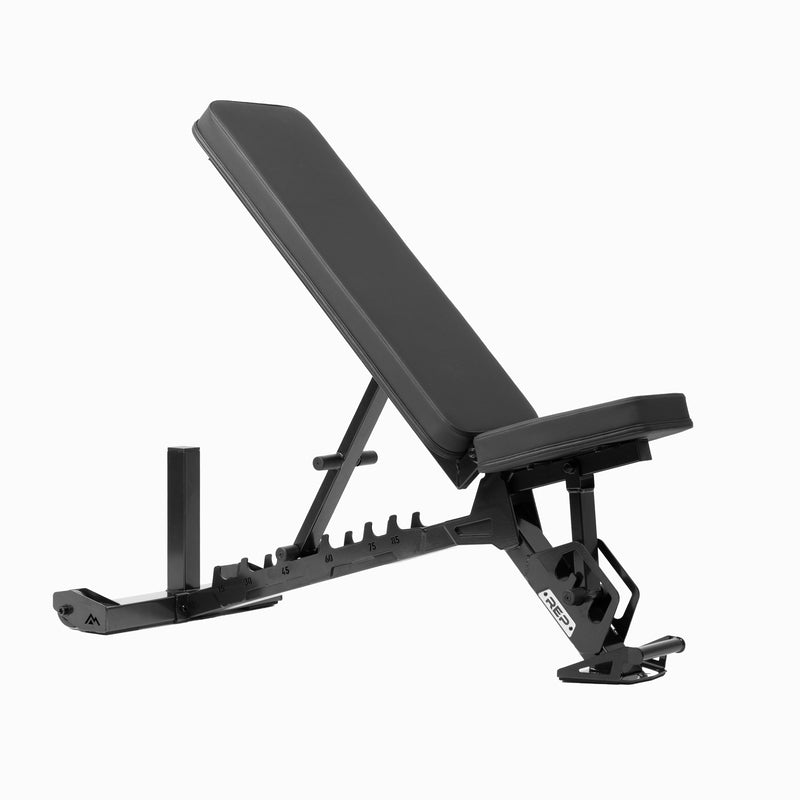
REP lists seven back-pad angles: 0°, 15°, 30°, 45°, 60°, 75° and 85°. The seat pad has three positions at 0°, 15° and 30°. The maker describes the bench as covering common first-home-gym exercises, but the actionable distinction is simpler: its back moves from flat through incline, not below flat. REP explicitly answers that the back has no decline position.
The product page also says the Phantom is not compatible with bench attachments. That rules out treating a separately sold leg roller as an upgrade path to decline; the page names the Ares 2.0 footplate as compatible, but that is a rack-system accessory rather than a decline attachment. REP does not list an included leg-restraint assembly in the reviewed page. If decline or a restrained lower-body setup is essential, compare a bench whose exact supplied arrangement documents those functions instead of assuming a pictured add-on will fit.
How the published package differs from REP's other adjustable benches
The Phantom's closest simple comparison in REP's current library is the AB-3100. Both are listed at 70 lb and use wheels for movement, and both provide flat and incline. The AB-3100 is rated at 700 lb by REP, versus 500 lb for the Phantom; it lists a 90° back setting, while the Phantom's top angle is 85°. The Phantom lists a built-in vertical-storage post, which the AB-3100 does not have. Their dimensions are close—REP gives the Phantom as 50.3 by 22.7 inches and the AB-3100 as 50.5 by 23 inches—but REP has not supplied a square-foot use-area figure for the Phantom in the source checked here. Do not convert that near-match into a maker-stated footprint or treat its body dimensions as workout clearance.
The Nighthawk is another flat-to-incline option with an upright-storage post, but its maker-stated rating is 700 lb and its listed mass is 88 lb. Its back-angle list reaches 85°, like the Phantom, and REP describes a different closed-ladder arrangement. The comparison is about documented specifications, not a stability, feel or durability test. A lower published capacity does not prove that a bench is unsafe for a particular lifter; it does mean that a buyer who requires a rating above 500 lb should not count the Phantom as meeting that written threshold.
Pad, frame and room planning
REP lists a 34.8-inch-long, 11.8-inch-wide back pad and a 13-inch seat pad that tapers from 11.8 to 8 inches. The frame is described as 14-gauge steel and the upholstery as CleanGrip. These are manufacturer descriptions; they do not establish a preferred pad width, how the material will feel to a particular user, or how long the surface will last. The published body dimensions are 50.3 inches long, 22.7 inches wide and 16.7 inches high. Add the rack, bar path, walking route and the space needed to stand and retrieve the bench before deciding whether the room works.
REP documents wheels for rolling the bench and a rubber-lined post for standing it upright between sessions. Those solve different problems: the wheels move it along the floor, while the post changes its storage position. Unlike REP's flat benches that use a separately mounted wall hanger, the Phantom's upright post is part of the bench. The product page does not provide a stored-area or movement-clearance measurement, so plan the storage location and lifting route from the assembled unit rather than treating “vertical storage” as a complete room-fit measurement.
Model identity and availability checks
The manufacturer feed identifies three Phantom SKUs: AB-3102-MBLK (Metallic Black), AB-3102-MAT (Matte Black) and AB-3102-WHT (White). The only option axis is Color; no functional pad or frame selection is encoded, and REP lists the same 70-lb bench weight for all three. These are finish variants of the AB-3102 bench, not three separate adjustment designs. The integrated Metallic Black product image is mapped to the exact AB-3102-MBLK variant; it is not evidence of any performance claim.
On the date checked, REP's Coming Soon collection included the Phantom, its product page displayed a notification action, and all three product-feed variants were unavailable. The saved product page did not give a dependable launch or ship date. Recheck the exact listing and seller terms if its status changes; do not infer present stock or an order window from the product's published specifications.
For an immediately matchable flat-to-incline comparison, use the bench finder with flat and incline selected and read the current assessments. The Phantom remains a documented reference until REP makes a purchasable offer available and its eligibility can be reviewed again.
Who should keep this on a watch list?
The Phantom is worth comparing if REP's specified 70-lb frame, 0°–85° back range, 500-lb rating, wheels and integrated upright-storage post align with the intended space and training. It is not a documented answer for decline, a higher minimum capacity, or bench-attachment compatibility. Its 16.7-inch listed flat height may matter to a user comparing a specific rule or rack geometry, but verify the complete setup and the relevant requirement rather than relying on a single dimension. Until the maker changes the unavailable status, the practical next step is to compare eligible, documented alternatives—not to treat this article as a buying link.
Key specifications
Key details at a glance
| Adjustment range | Flat / incline |
|---|---|
| Manufacturer-stated capacity | 500 lb |
| Bench weight | 70 lb |
| Length | 50.3 in |
| Width | 22.7 in |
| Height when flat | 16.7 in |
| Back-pad positions | 0 / 15 / 30 / 45 / 60 / 75 / 85° |
| Seat-pad positions | 0 / 15 / 30° |
| Vertical storage supported | Yes |
| Transport wheels shown | Yes |
Use the exact model’s instructions for operating limits, supplied equipment and version differences.
Sources for this review
Sources for this assessment
Compare the constraints that matter to you
Use the finder to compare currently researched benches, and opt in to the five separately assessed earlier REP configurations or families only when checking an existing or used offer. Match the exact model, edition and manual; the catalogue is still being expanded.