
Your needs, this model
Does it fit your priorities?
Does the original AB-5200 decline like the Adjustable-post 2.0?
No. REP's comparison says the original AB-5200 is flat/incline only. The three negative angles belong to the 2.0's optional Adjustable post, not this original model. Confirm the suffix and post before relying on a used listing photo.
Explore this need in the finder →What did the original AB-5200 change in the 2.0 redesign?
REP lists the original at 125 lb, 18 inches high and a 2-inch pad gap; it has seven back and three seat angles and stores vertically. The 2.0 is listed at 115 lb with a 1.4-inch gap and finer angle steps. The newer post choices also determine whether decline is available. These are distinct editions, not finish variants.
Explore this need in the finder →Is the original AB-5200 compatible with a Wide pad?
REP's original-model introduction says a Wide pad is compatible and explains that it is a separate order; the 2.0 instead offers pad choice at the initial configuration step. This source does not provide a current wide-pad SKU bridge for an existing original bench, so verify exact pad and model compatibility before buying parts.
Explore this need in the finder →Can I stand this original model upright?
REP's original-versus-2.0 comparison says both models are designed for vertical storage. The older bench lacks the protective liner that REP added to the 2.0 stand, so check the exact manual, floor surface and storage clearance before moving it upright.
Explore this need in the finder →This assessment is for the original REP AB-5200 Adjustable Weight Bench, before the 2.0 redesign. REP’s own comparison article gives the clearest model boundary: both generations are flat/incline benches with a closed ladder and upright-storage design, but the original does not decline. A current product route for the old name redirects to AB-5200 2.0, so a present-day listing that simply says “AB-5200” needs careful version checking.
What the original model offers
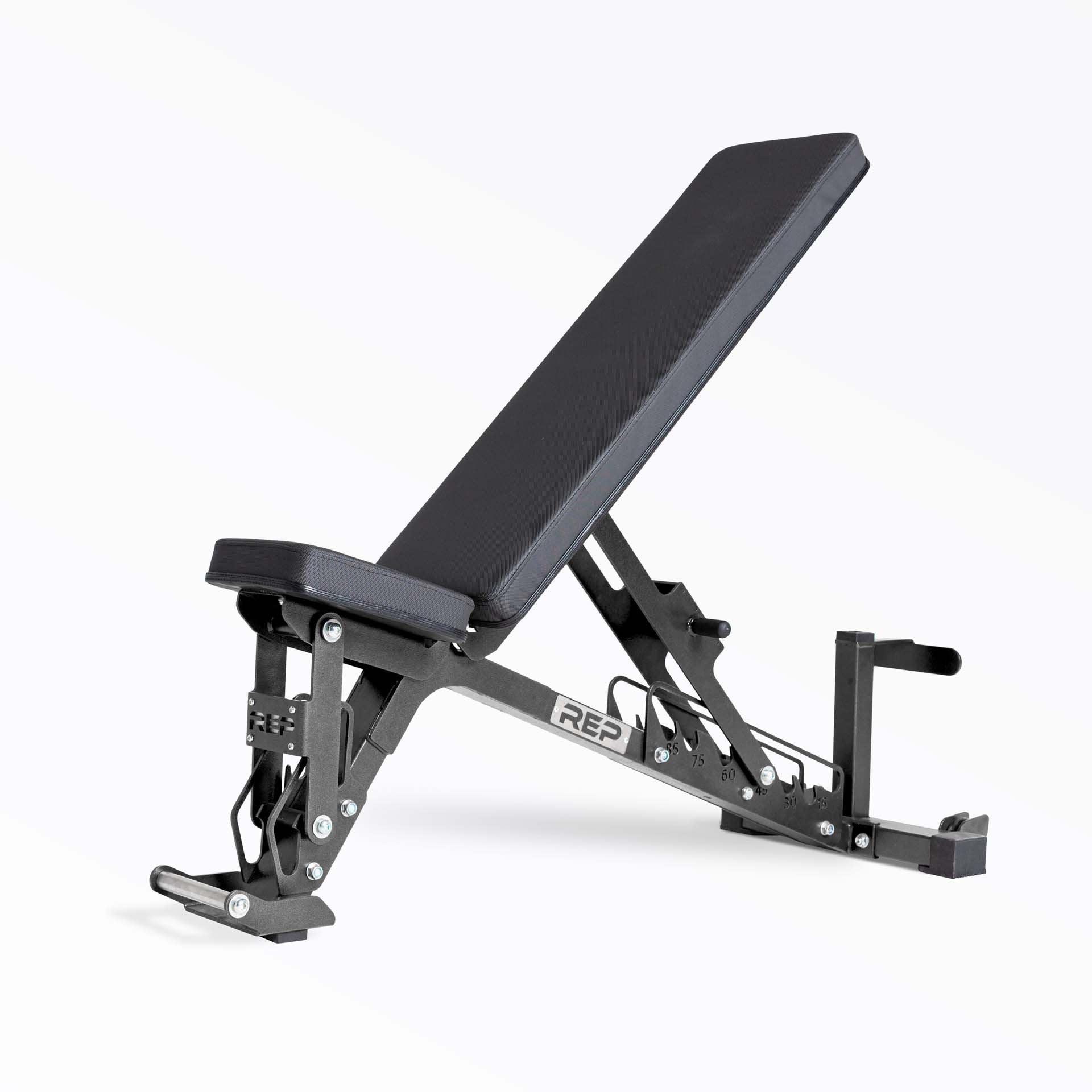
REP lists seven back angles—0, 15, 30, 45, 60, 75 and 85 degrees—and three seat angles—0, 15 and 30 degrees. The closed ladder holds the selected incline without the AB-5000-style pop-pin mechanism. Its 2-inch pad gap is a manufacturer measurement, not a comfort rating. REP’s introduction describes a 42-inch back pad and 55.3 inches of total pad length, a useful dimension for assessing torso support, but the sources here do not give the complete width, length, floor footprint or clearance envelope.
The manufacturer comparison lists 125 lb for the original bench, 18 inches of flat height and a 1,000-lb capacity. REP describes upright storage and a horizontal handle. The 18-inch height is above the IPF bench range REP cites when discussing the 2.0; anyone training toward a competition setup should not assume the original duplicates the newer model’s height. The rating is a maker claim and this research does not establish an independent test or combined user-and-weight interpretation.
Do not confuse it with the configurable 2.0
The newer AB-5200 2.0 weighs 115 lb according to REP—10 lb lighter than the original—and has a 1.4-inch rather than 2-inch gap. Its fixed post provides ten back angles and four seat options, while the selectable adjustable post adds -8, -6 and -4 degrees. The original has no such decline. A used original cannot gain those settings merely because a 2.0 photo or description appears beside it. Check the serial/model label, frame geometry and manual, not just the family number.
Pad and accessory wording also differs by generation. REP says the original came with standard pads and that a wide pad had to be ordered separately; its introduction mentions a spotter platform option. The 2.0 lets a buyer select a standard or wide pad during configuration and its option records use separate component codes. The sources reviewed here do not provide an exact current wide-pad code for the original or establish that a 2.0 pad or platform fits it. Do not treat an accessory as part of the used bench’s price or package until the exact piece is identified.
Vertical storage has a practical cost
REP says both generations can be stood vertically, but the 2.0 adds a protective plastic liner to its improved metal stand. That difference is worth checking on an older unit. Before tipping a bench upright, inspect its support point and manual, confirm the floor can tolerate the contact, and leave enough height and clearance to handle its 125-lb mass. The nominal storage claim is not the same as a measured storage plan for a tight room.
The old AB-5200 source also contrasts its wider steel profile and greater weight with the redesigned version. Those claims help explain the revision, but they are not a side-by-side stability test. The old bench remains substantial equipment, and the available guide does not quantify its full footprint or moving route. Measure the actual frame and storage location if either controls the purchase.
Model and manual limits
REP’s introduction and original-versus-2.0 comparison identify the old configuration and its principal differences. An assembly PDF returned at the official AB-5200 filename did not resolve the manual question: its metadata identifies an AB-5000 manual and its scanned pages do not establish a model-specific AB-5200 instruction sheet. That file is deliberately not used to claim exact assembly or component identity. Ask REP for the correct original manual and match it to the individual offer before assembly or use.
This review is therefore useful as a version reference, especially when the decision turns on decline, gap, height, mass or upright storage. It is not a new-unit recommendation or a claim of ownership or testing. For a used bench, verify the original model suffix, intact closed ladder, pads and stand, included hardware, separate accessories and seller terms. The sound conclusion is that the original AB-5200 is a 125-lb, flat/incline-only, upright-storing model with a 2-inch gap and published 1,000-lb rating; current 2.0 features must not be attributed to it.
Key specifications
Key details at a glance
| Adjustment range | Flat / incline |
|---|---|
| Manufacturer-stated capacity | 1000 lb |
| Bench weight | 125 lb |
| Height when flat | 18 in |
| Back-pad positions | 0 / 15 / 30 / 45 / 60 / 75 / 85° |
| Seat-pad positions | 0 / 15 / 30° |
| Pad gap | 2 in |
| Leg restraint included | No |
| Vertical storage supported | Yes |
Use the exact model’s instructions for operating limits, supplied equipment and version differences.
Sources for this review
Sources for this assessment
Compare the constraints that matter to you
Use the finder to compare currently researched benches, and opt in to the five separately assessed earlier REP configurations or families only when checking an existing or used offer. Match the exact model, edition and manual; the catalogue is still being expanded.