
Your needs, this model
Does it fit your priorities?
Does this model support decline pressing or sit-ups?
No. REP describes the AB-3100 as flat-to-incline, with six back settings from 0° through 90°. Its product FAQ states it has no leg-roller option. Choose a separately researched FID configuration if decline is essential.
Explore this need in the finder →What should I know about its size if my training corner is tight?
REP lists a 50.5-by-23-inch body and 7.9-square-foot footprint, with 70-lb bench weight. It is lighter and has a smaller listed footprint than the AB-3000 2.0, but REP says the AB-3100 cannot be stored vertically; it still needs floor space when not in use.
Explore this need in the finder →Is its back adjustment the same as the AB-4100?
No. The AB-3100 has an open ladder and six back positions (0°, 30°, 45°, 60°, 75°, 90°); REP's FAQ identifies the AB-4100 as a closed-ladder bench with seven settings ending at 85°, a uniform 12-inch pad, and a vertical-storage design. The AB-4100 itself remains a separate unresolved catalog identity in this research cycle.
Explore this need in the finder →This assessment is based on REP’s current U.S. AB-3100 product page and bench guide; we have not handled, assembled, or load-tested the bench. Its role in the line is more specific than “budget adjustable”: it gives a flat-to-incline range, but it does not add decline or an included leg restraint. That distinction can matter more than the number of frame colors or the word “heavy-duty” on a listing.
A straightforward flat-to-incline design
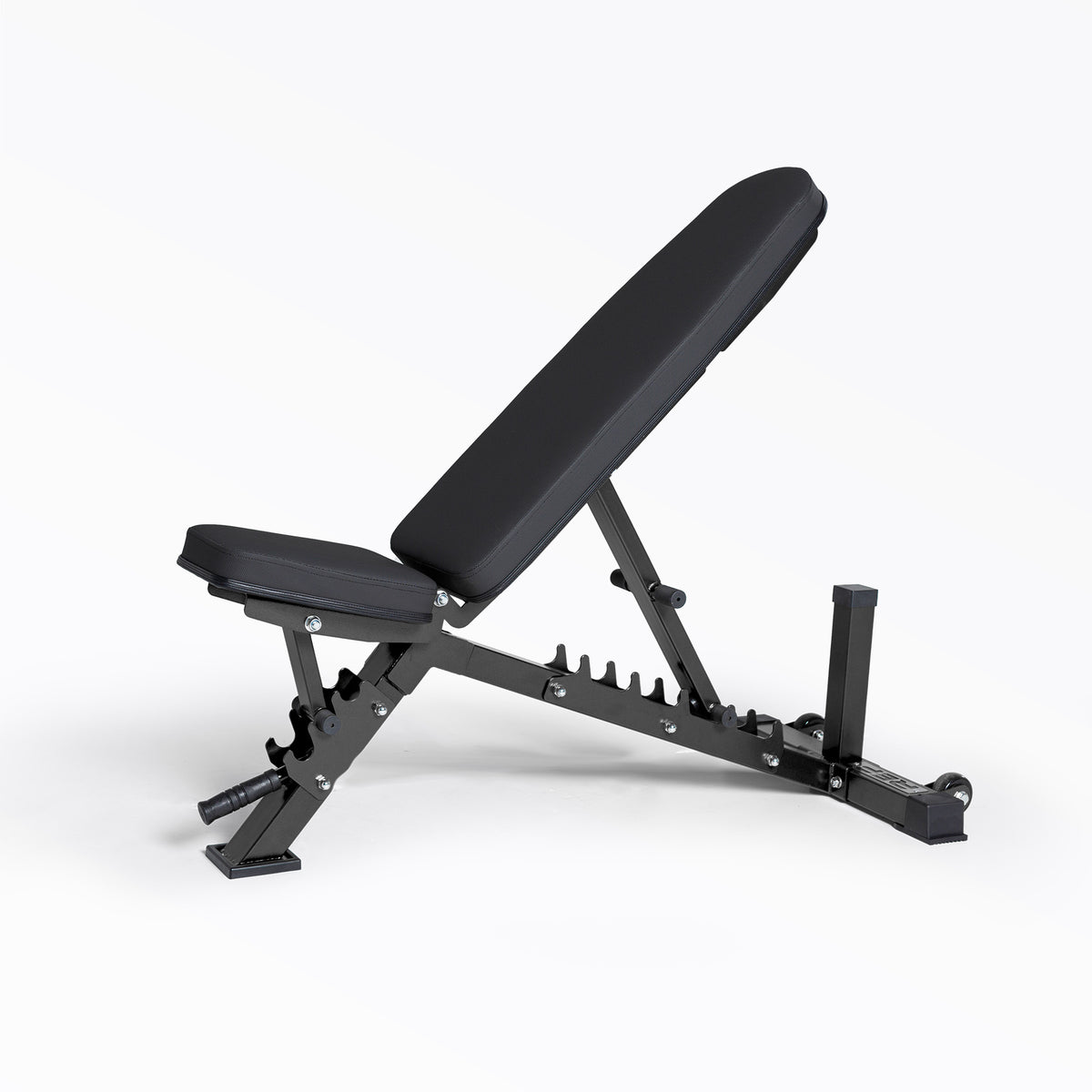
The AB-3100’s back pad has six published positions: 0°, 30°, 45°, 60°, 75°, and 90°. The seat has three: 0°, 10°, and 20°. This arrangement covers flat work and several incline angles, including a fully upright back position, but there is no negative back angle. REP explicitly describes the bench as flat-to-incline and says it has no decline position. If decline pressing, decline sit-ups, or an included way to secure the legs is non-negotiable, this is the wrong configuration to shortlist.
REP’s page describes an open ladder adjustment and a three-post frame. The three contact points and rubber grip feet are intended to keep the frame supported while leaving room around the front post for foot placement. Those are design choices, not evidence that a particular floor, shoe position, or lifting style will feel stable to every person. The manufacturer lists the frame at 14- and 4-gauge steel and gives it a 700-lb capacity rating. Treat that as REP’s stated specification rather than an independent test result, and ask how the rating applies to the user-plus-load arrangement you have in mind.
Smaller on paper, but not an upright-storing bench
The listed bench weight is 70 lb. REP gives dimensions of 50.5 inches long by 23 inches wide, a flat height of 16.75 inches, and a 7.9-square-foot footprint. Those numbers make it lighter and smaller than the AB-3000 2.0 in the same manufacturer’s lineup. They do not mean it disappears after training: REP’s product FAQ says the AB-3100 is not designed for vertical storage. Measure the space where it will sit during use and where it must remain when the workout is over.
The standard back pad is 34.75 inches long and tapers from about 11.75 to 9 inches wide. The seat is 13 inches long and tapers from 10.5 to 8 inches. REP lists a 1.7-inch pad gap. If shoulder support, a broader pad, or a gapless surface is central to your preference, these measurements deserve a closer look before you order. The standard cover is described as textured non-slip vinyl; the description is not a promise that the surface will suit every shirt, movement, or cleaning routine.
How it differs from REP’s AB-3000 2.0
The two models solve different needs. The AB-3100 weighs 70 lb, has a 7.9-square-foot stated footprint, and reaches 90°; the AB-3000 2.0 weighs 89.3 lb, has a 9.85-square-foot stated footprint, and reaches -12° for decline. REP rates the AB-3100 at 700 lb and the AB-3000 2.0 at 1,000 lb. The AB-3000 2.0 includes a six-position leg roller, while the AB-3100 does not. None of those differences alone tells you which bench is better for your room or training plan. If you mainly use flat and incline angles, the AB-3100 avoids paying floor space and weight for a decline setup you may not use; if decline is part of your routine, its limitation is decisive.
Do not confuse it with the AB-4100
REP’s AB-3100 FAQ compares it with an AB-4100: the latter has one additional back angle, a closed rather than open ladder, a uniform 12-inch-wide pad, a vertical-storage design, an upgraded handle, and a different stated height-standard status. Those are functional distinctions, not alternate colors. However, the current REP category inventory observed for this checkpoint lists a Nighthawk model rather than a separately selectable AB-4100. We have not yet resolved the exact relationship between the current Nighthawk and historical AB-4100, so this review does not silently merge them.
Who should shortlist it
Consider the AB-3100 if a smaller and lighter flat-to-incline bench matches your actual space and exercises, and if a 700-lb manufacturer rating is adequate for your intended use. Pass over it if you require a decline angle, a built-in leg restraint, or vertical storage. Before buying, confirm the exact AB-3100 model and color, read REP’s current assembly instructions, compare the real bench and pad dimensions with your lifting space, and verify the maker’s capacity guidance for your setup. The pictured metallic-black unit represents one cosmetic finish among four listed options; the finish does not create a different model assessment.
Key specifications
Key details at a glance
| Adjustment range | Flat / incline |
|---|---|
| Manufacturer-stated capacity | 700 lb |
| Bench weight | 70 lb |
| Length | 50.5 in |
| Width | 23 in |
| Height when flat | 16.75 in |
| Base footprint area (listed or calculated) | 7.9 sq ft |
| Back-pad positions | 0 / 30 / 45 / 60 / 75 / 90° |
| Seat-pad positions | 0 / 10 / 20° |
| Pad gap | 1.7 in |
| Leg restraint included | No |
| Leg-roller positions | 0 |
| Vertical storage supported | No |
| Transport wheels shown | Yes |
Use the exact model’s instructions for operating limits, supplied equipment and version differences.
Sources for this review
Sources for this assessment
Compare the constraints that matter to you
Use the finder to compare currently researched benches, and opt in to the five separately assessed earlier REP configurations or families only when checking an existing or used offer. Match the exact model, edition and manual; the catalogue is still being expanded.