
Your needs, this model
Does it fit your priorities?
Does the WPPO bench document a flat position?
Yes. Eleiko identifies it for para-powerlifting bench press competition and training. The adjustment hardware described is for the bar rests and safety catches; the checked sources do not document an incline or decline bench-pad setting. This is a specialist flat competition station, not a general adjustable bench.
Explore this need in the finder →What does its roughly 772-lb figure represent?
Eleiko lists maximum training weight as 350 kg / 771.62 lb and gives a separate maximum user weight of 180 kg / 396.83 lb. Treat those as distinct maker limits; do not add them together or substitute the training-weight number for a complete safety plan.
Explore this need in the finder →What should be checked before planning floor space or installation?
The product sheet lists 2228 x 1245 x 1095 mm, while the linked manual prints a conflicting 98-inch length despite repeating 2228 mm. The manual also specifies at least 0.6 m clearance on every side and recommends a stable, level base secured to the floor by a licensed contractor or Eleiko installer. Measure the room and anchoring surface against the current manual and offer; no footprint number is entered in the finder.
A specialized competition bench, not a general adjustable bench
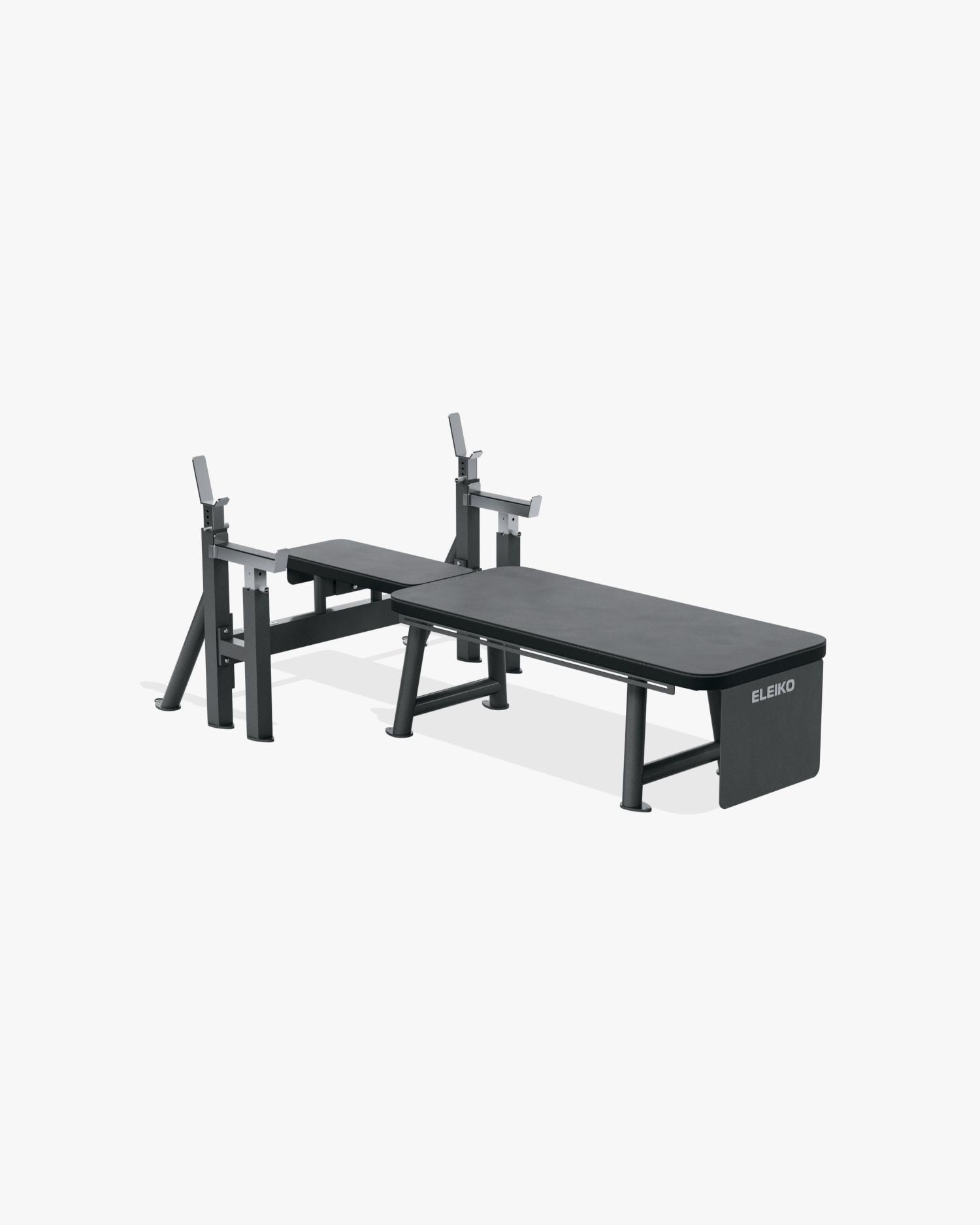
The Eleiko WPPO Powerlifting Bench Press, Charcoal, is identified by article code 3085532-060. Eleiko describes it for World Para Powerlifting Organization competition and training, and says the bench is sold individually. Its useful distinction is the integrated competition setup: the source sheet describes a broad support surface below the torso transitioning to a standard bench width, adjustable bar rests, and chrome safety catches. That makes this a purpose-specific flat powerlifting station rather than a conventional flat/incline/decline home bench. The maker's WPPO certification is a source claim, not a certification I independently checked.
Eleiko lists 21 bar-rest height settings at 20 mm increments and nine safety-catch settings at 50 mm increments. Those adjustments help position the bar and safeties; they do not establish incline or decline back-pad angles. If your routine calls for an ordinary adjustable bench, this distinction matters more than the large load number: the product material reviewed here does not describe a movable incline pad, leg restraint, wheels or upright storage.
Keep the two load limits separate
The product sheet gives a maximum user weight of 180 kg (396.83 lb) and a maximum training weight of 350 kg (771.62 lb). These are two differently named limits. The second is what this site's numeric finder compares with a stated training-weight threshold; it is not a calculation that combines the lifter and bar, and it is not a load test performed for this review. Ask Eleiko or the authorized seller exactly how the figure applies to the intended user, bar and competition setup. A qualifying number does not replace a properly set bar rest, safety catch, supervision or strength-appropriate loading.
The pad is described as firm and designed for lifting, but no pad-width measurement appears in the product sheet. The maker says the support surface transitions from wider below the torso to standard width. I would not translate that sentence into a specific width, a choice of pad option or an adjustment feature: the checked U.S. page identifies one Charcoal article code and does not show a pad selector.
Room and installation require more than the headline dimensions
At 74 kg (163.14 lb), this is a heavy equipment purchase. Eleiko's sheet lists overall dimensions of 2228 × 1245 × 1095 mm (87.72 × 49.02 × 43.11 in). The linked manual repeats the metric values but also prints 98 × 49 × 43 in; 2228 mm is not 98 in. Its footprint diagram gives another cross-width, 1234.74 mm. Because the maker documents disagree, I have not used a calculated floor area in the finder. Do not substitute the shipping route, a diagram or this listing for a site measurement.
The user manual says indoor use on a stable, level base, recommends that Eleiko equipment be secured to the floor, and advises installation by a licensed contractor or Eleiko installer. It also calls for at least 0.6 m of clearance on every side so a loader can remove and replace the bar and weights. That is manufacturer setup guidance, not the bench's footprint. Check slab or floor construction, fasteners, doorway and delivery route, and clear working space before requesting a quote or scheduling installation.
What is not included or established
Eleiko says Velcro straps are available as an accessory if needed, so do not assume they are part of the 3085532-060 bench package. The product page also links a separate manual for WPPO bench lever arms, article 3085814; that is a different component, not evidence it ships with this bench or that it suits a particular athlete. Confirm the accessory, part number and current U.S. offer directly before adding it to a purchase plan.
The warranty information is another check rather than a settled advantage. The product sheet presents a broad “1–10 years” field, while the linked manual's general warranty section says two years and 90 days for upholstery. The two sources do not explain the difference for this exact U.S. article code. Request the current written terms and confirm whether they apply to the bench, pad, competition use, installation and original purchaser.
Who should compare it—and who should pass
This is worth considering only when its specific para-powerlifting competition format is actually required, the user and training limits suit the lifter and bar, and a facility can handle the anchoring, supervised use, clearance and heavy delivery. Its integrated safety hardware and certified competition purpose are meaningful product attributes, but neither is a substitute for a sport-specific fit check. For general dumbbell training, ordinary bench pressing at home, adjustable incline work or a bench that must be moved and stored, the sources do not establish the features you would need.
Before ordering, verify the exact 3085532-060 Charcoal designation, current U.S. availability and service terms, the separate 180 kg user and 350 kg training-weight limits, room and delivery dimensions, floor anchoring, bar-rest/safety-catch settings, and whether optional straps or lever arms are in the actual package. Follow the current manual and have the equipment installed and inspected as the manufacturer directs. This is a document-based assessment; I did not use, assemble, measure or load-test the bench.
Key specifications
Key details at a glance
| Adjustment range | Flat only |
|---|---|
| Manufacturer-stated capacity | 771.62 lb |
| Bench weight | 163.14 lb |
| Height when flat | 19.29 in |
Use the exact model’s instructions for operating limits, supplied equipment and version differences.
Sources for this review
Sources for this assessment

Compare the constraints that matter to you
Use the finder to compare currently researched benches, and opt in to the five separately assessed earlier REP configurations or families only when checking an existing or used offer. Match the exact model, edition and manual; the catalogue is still being expanded.