
Your needs, this model
Does it fit your priorities?
Does this model adjust beyond flat?
No adjustable back positions are listed for the FLT2-BEN Powerlifting Flat Bench; the manufacturer describes a fixed flat design. If incline or decline is essential, choose a model whose exact offer documents those positions instead.
Explore this need in the finder →How wide and thick is its pad, and how does that compare with space?
Bells lists a 12-inch pad width and 4-inch thickness. The product table gives a 50-by-24.5-inch length/width envelope, which calculates to about 8.51 sq ft; this is not barbell access or room clearance.
Explore this need in the finder →Are the wheels the same as vertical storage, and what rating is published?
The page documents rear wheels and a handle for repositioning and a 1,000-lb maximum, but it does not document upright storage or explain how user weight and external load combine. The linked manual calls for a flat indoor floor and clearance around the exercise area; confirm the written load and anchoring guidance with the maker.
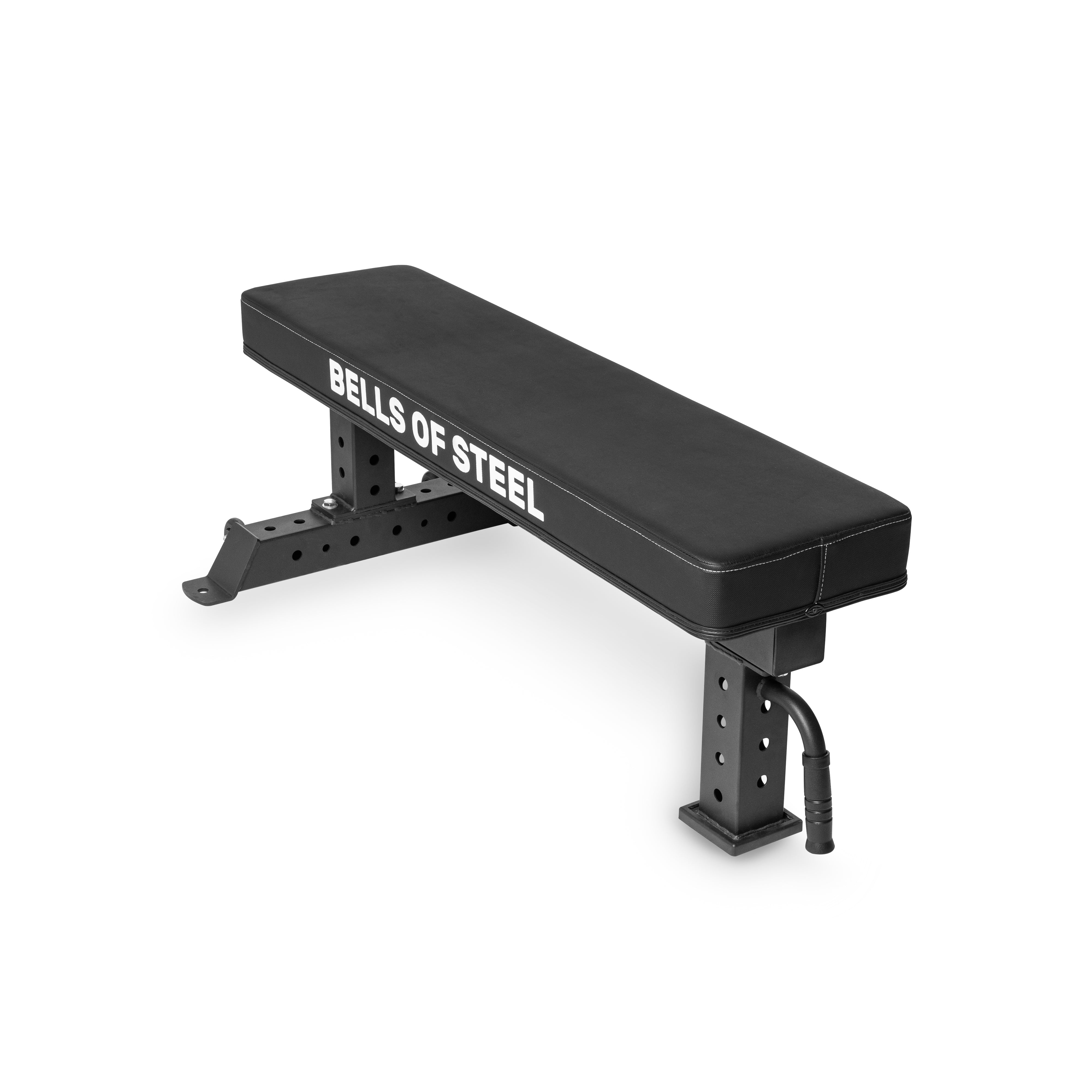
Explore this need in the finder →The Bells of Steel Powerlifting Flat Bench is the fixed-flat member of this current two-bench group. Its exact parent-feed offer is FLT2-BEN. Bells lists a 12-inch-wide, 4-inch-thick pad, rear wheels and handle, 5/8-inch frame holes, and a 1,000-lb maximum claim. Those details make the bench worth comparing for a flat-press routine, but they do not turn it into an adjustable FID bench or establish an independent load rating.
A fixed flat bench, not a substitute for adjustable positions
The current Powerlifting Flat Bench page identifies a flat bench and supplies no incline or decline adjustment schedule. Its role is narrower than that of the commercial FID2-BEN: it offers a broad, thick surface for flat work rather than multiple back angles. If incline or decline is essential, this model should not be counted as a match just because it is sold by the same company.
The source table lists the pad as 12 inches wide and 4 inches thick. Those measurements describe the surface, not whether it suits every lifter's shoulder position, arch, grip or technique. The page also says the design allows the feet to tuck under for pressing, but that is a maker description rather than an individualized fit test. A lifter who competes should verify the current federation's bench dimensions and rule language directly; the product page's “powerlifting” name is not itself a rules certification.
Its footprint is measurable, but your room still needs more
Bells lists a 50-inch length, 24.5-inch width and 17-inch height. The length-by-width rectangle calculates to about 8.51 square feet. That gives a concrete starting point for the bench base; it does not include the space to load plates, handle a bar, walk around the bench, reach a rack or move the equipment through a doorway. The manufacturer manual advises a flat indoor surface and at least two feet (60 cm) of free space around the equipment for the intended exercise. Do not confuse that clearance with the 8.51-square-foot base.
The product page lists 43.60 lb as bench weight. The parent collection variant record separately reports 23,269 grams, but does not explain what its weight field represents. Because the source page clearly labels the bench's own 43.60-lb specification and the feed's field has no stated basis, I do not blend them or claim a measured mass. A listed weight is not a promise that every user can safely lift or move the bench.
Wheels, holes and anchoring each answer a different question
The maker describes rear wheels and a handle for repositioning. It also says the bench can be bolted down for additional stability. These are different operating choices: the wheels assist a move when used as intended, while anchoring is an installation decision that depends on the floor, fasteners and instructions. The page does not state an exact anchor type or establish that anchor hardware is included, so check the manual and ask the manufacturer before drilling into a floor.
The current page identifies 5/8-inch drilled frame holes and suggests using the company's Utility Hooks to store loadable dumbbell handles when the bench is fixed as a station. It does not list those hooks in the FLT2-BEN package, and a hole diameter alone does not prove compatibility with an arbitrary rack, attachment or accessory. The included-items list says one flat bench and a hardware pack. Treat any add-on as a separate, exact-fit question.
Read the maximum and warranty language carefully
Bells publishes a 1,000-lb maximum (also displayed as 454 kg). Its page does not define whether user weight and external plates are combined in that figure, and the materials reviewed provide no independent load-test report. A manufacturer rating is a screening fact, not a personal safety recommendation. Ask Bells how the rating applies to your intended setup and use the bench only as directed in the current instructions.
There is also a real source inconsistency worth resolving before a purchase: the specification table lists 90 days for pad and wheels, while feature copy says 180 days for wheels, grips and upholstery; both refer to limited lifetime frame coverage. I cannot choose one term on the manufacturer's behalf. Check the written warranty attached to the exact SKU and seller offer. The page's Version 2.0 Upgrades subsection lists drilled holes, premium vinyl, a sandy powder coat and a rubber pad on the front foot. The observed title and feed identity remain Powerlifting Flat Bench, SKU FLT2-BEN; the page's wording is preserved rather than used to create a second model listing.
Who should compare FLT2-BEN
This is a focused candidate when the required position is flat, the thick pad and 12-inch width suit the plan, the base rectangle fits after adding clearance, and the maker's published maximum is adequate once clarified. It is a weak choice when you need a decline restraint, adjustable angles, documented upright storage, or certainty about the warranty before the page's conflicting wording is resolved. It has no position settings to manage, but assembly, hardware inspection and floor setup still matter.
The linked five-page FLT2-BEN manual identifies the same SKU and covers the parts, assembly and general safety instructions. Follow it, recheck fasteners, and plan the clearance around the full exercise. This is an assessment of source material, not a claim of ownership or hands-on experience: no assembly, measurement, fit, stability or load test was performed.
Key specifications
Key details at a glance
| Adjustment range | Fixed flat powerlifting |
|---|---|
| Manufacturer-stated capacity | 1000 lb |
| Bench weight | 43.6 lb |
| Length | 50 in |
| Width | 24.5 in |
| Base footprint area (listed or calculated) | 8.51 sq ft |
| Leg restraint included | No |
| Transport wheels shown | Yes |
Use the exact model’s instructions for operating limits, supplied equipment and version differences.
Sources for this review
Sources for this assessment
Compare the constraints that matter to you
Use the finder to compare currently researched benches, and opt in to the five separately assessed earlier REP configurations or families only when checking an existing or used offer. Match the exact model, edition and manual; the catalogue is still being expanded.