
Your needs, this model
Does it fit your priorities?
Which positions does the UAD-BEN-SET document?
Bells lists seven back-pad choices: decline, flat, and five incline settings, plus five seat positions. The source does not publish the exact degrees, so verify the current locking pattern in the product instructions rather than assuming a specific angle schedule.
Explore this need in the finder →Does this package include a decline restraint?
The product page lists the bench, hardware pack, pop pin, two wheels and a handle knob as included. It does not list a leg restraint. The future-adapter compatibility note does not establish an included support attachment, so choose an exact package that documents a restraint if that is essential.
Explore this need in the finder →What is known about moving or storing it?
The maker lists two wheels and a built-in handle, and permits upright storage only with a level floor or a suitable bench hanger. It does not publish the bench's assembled base footprint or stored envelope; measure both the exercise space and the storage route.
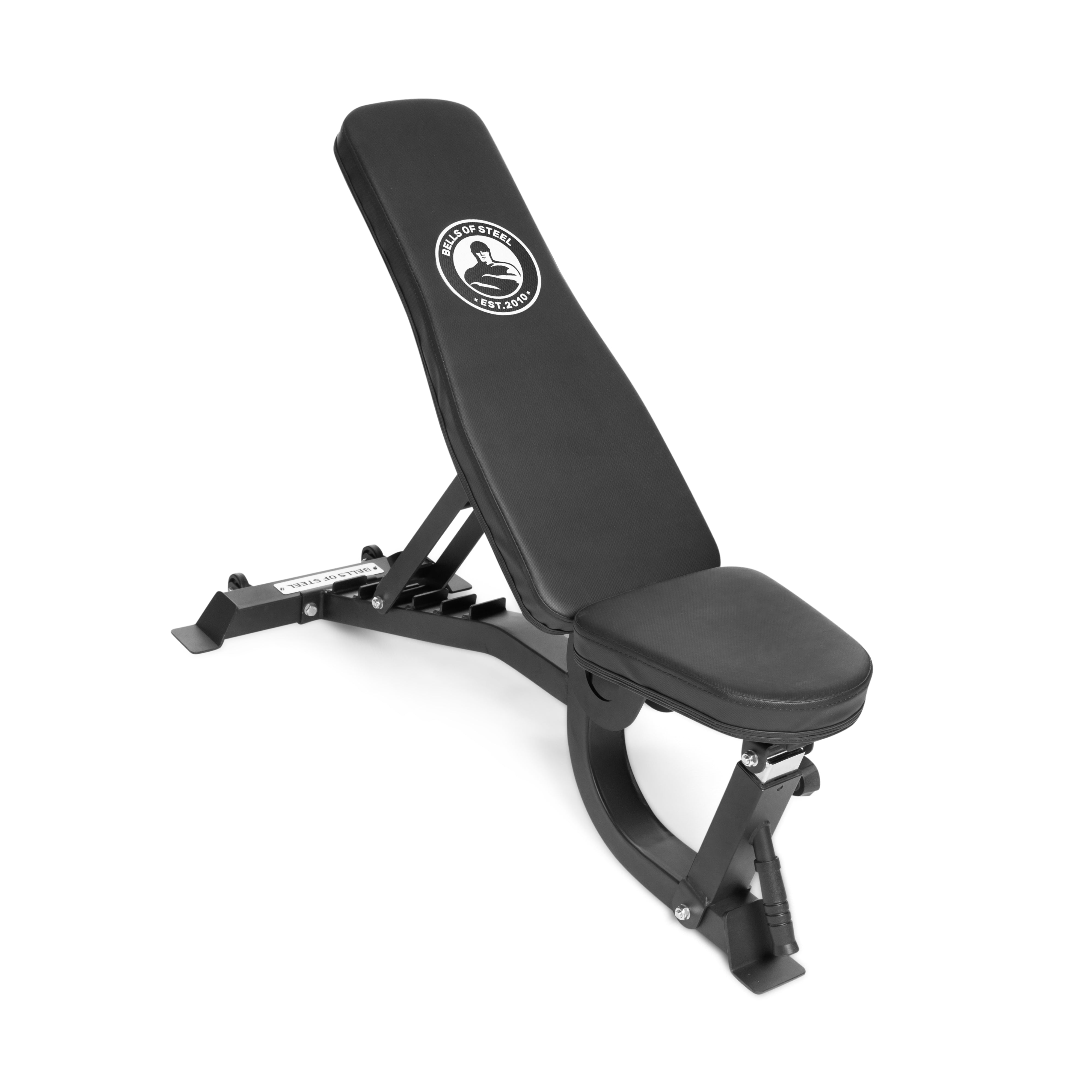
Explore this need in the finder →The Bells of Steel Adjustable Utility Bench (U.S. SKU UAD-BEN-SET) is a straightforward FID design: seven back-pad choices—decline, flat and five incline settings—with a separately adjustable five-position seat. The manufacturer also lists a 575-lb maximum capacity, a 55-lb bench weight, a 2.3-inch pad, two wheels and a handle. Those specifications make this a meaningful comparison for someone who needs a wide position range but not a large attachment package. They do not make it a complete answer for every decline routine: no leg restraint appears in the current included-parts list.
Its useful distinction is a full back-pad range
Some adjustable benches stop at incline. Bells describes this model as offering decline as well as flat and five positive angles, so the bench covers the three broad position families without relying on an optional conversion. Its five seat positions are a separate adjustment; they should not be mistaken for five more back-pad angles. The page gives the number and names the types of settings but does not publish an exact degree-by-degree schedule. If your routine depends on a particular angle or a specific seat/back combination, confirm the current setting labels and locking procedure in the instructions before ordering.
The product page frames the bench as a leaner utility option than the company's heavier adjustable models. That is a useful category description, not a comparative load test. Its 55-lb maker-listed mass and built-in wheels suggest a bench intended to be moved around a home setup, while the small user-facing interface is the familiar back support, seat and adjustment hardware. Buyers who want a dedicated leg developer, preacher pad or other exercise station should not assume one comes with this SKU.
Decline range does not mean decline restraint
The included-parts list names the bench, hardware pack, pop pin, two wheels and handle knob. It does not name a leg roller or other leg restraint. That distinction matters more than the FID label: a negative back setting and a means of securing the lower body are different features. A person who requires an included restraint should filter for that exact requirement rather than infer it from the bench's decline setting or from a photo of another Bells bench.
Bells says this bench can work with its attachments using a Universal Bench Adapter described on the product page as upcoming. That statement is not evidence that the adapter is included, presently available, or compatible with every attachment. If an add-on is part of your plan, confirm the exact adapter, attachment, fasteners and manual for the offer you are buying. The base UAD-BEN-SET assessment is for the bench as supplied, not a bundle assembled from separately named parts.
Read the 575-lb figure as a maker claim
The published maximum is 575 lb. It is useful as a screening value because the questionnaire asks for the manufacturer's stated capacity, but the page does not say whether that number means user weight, external plates, or a combined load. No independent test report is provided in the product material reviewed here. A buyer should ask Bells how its rating applies to their intended setup and should not treat the number as a personal safety recommendation.
The exact degree schedule, assembled base dimensions and flat height are also not given in the current product page or linked assembly manual. Shipping cartons are listed, but carton dimensions do not describe the assembled bench's exercise footprint. If a doorway, rack, room or floor-area limit is decisive, get the assembled measurements from the manufacturer and measure the space yourself; do not substitute the parcel size or the nominal 55-lb weight.
Wheels and upright storage need a level place
The product page lists two wheels and a handle, which can help with repositioning when the bench is tilted as intended. They do not establish that a 55-lb bench will be easy for every person to move, that it will turn through a narrow doorway, or that it folds. The page does discuss vertical storage, but it warns that an uneven floor can let the upright bench fall and suggests a bench hanger as an alternative. Treat this as a conditional storage feature: plan a level parking spot or check the exact hanger and mounting instructions, and reserve room for the bench's route into that position.
The linked assembly manual identifies the UAD-BEN family and asks for indoor use on a flat surface, secure fasteners and at least two feet of free space around the intended exercise area. That clearance instruction is not a bench-base measurement. It does make setup part of the purchase decision: check floor contact, assemble and tighten the hardware as directed, and periodically recheck fasteners rather than relying on a single initial inspection.
Who should compare it—and what to verify
This bench is worth comparing when flat, incline and decline are all part of the plan, a 575-lb maker rating is adequate after its meaning is clarified, and wheels are useful. It is a weaker fit when the bench must arrive with a decline restraint, when the buyer needs a stated assembled footprint, or when the intended load exceeds the maker's published number. A purpose-built low, sloped hip-thrust bench is a different task again; it should not be counted as a conventional adjustable-position substitute just because both products are called benches.
Before choosing the offer, check that the seller identifies SKU UAD-BEN-SET, confirm the current manual and angle labels, ask how the 575-lb maximum is defined, and verify whether a suitable restraint or adapter is actually included. Measure the training and storage spaces separately. This is a source-based assessment of published specifications and package information—not a hands-on review, fit test, assembly report or load test.
Key specifications
Key details at a glance
| Adjustment range | Flat / incline / decline |
|---|---|
| Manufacturer-stated capacity | 575 lb |
| Bench weight | 55 lb |
| Leg restraint included | No |
| Vertical storage supported | Yes |
| Transport wheels shown | Yes |
Use the exact model’s instructions for operating limits, supplied equipment and version differences.
Sources for this review
Sources for this assessment
Compare the constraints that matter to you
Use the finder to compare currently researched benches, and opt in to the five separately assessed earlier REP configurations or families only when checking an existing or used offer. Match the exact model, edition and manual; the catalogue is still being expanded.